
Originally published in October 2021 and comprehensively updated/edited in June 2026.
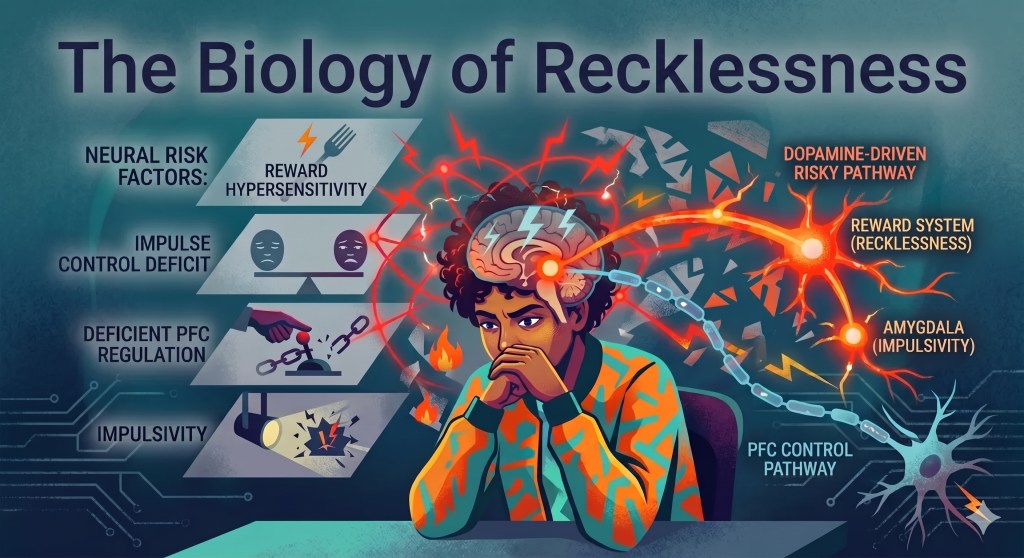
Explore the biology and psychology behind reckless behavior — how stress, dopamine, social contagion, and history combine to drive human risk-taking.
How Stress Rewrites Risk, Time, and Decision-Making
There is a particular mood that settles over societies in the wake of prolonged crisis. It isn’t quite relief, though relief is part of it. It’s something more combustible — a restlessness that builds when people who have been cooped up, frightened, and constrained finally sense the walls coming down. Historians have described these periods as moments of social release. Psychologists see them as stress rebounds. Neuroscientists increasingly recognize them as shifts in risk perception and reward processing.
The post-pandemic years offered a vivid modern example of a much older pattern. As vaccine rollouts progressed and lockdowns eased, something shifted in the collective temperament. Spending surged. Risk-taking increased. People made impulsive decisions about careers, relationships, and money. The phrase “YOLO economy” entered the cultural lexicon — a strange mix of fatalism and urgency, a sense that life was too short and too unpredictable to keep playing it safe.
But observers of history recognized the shape of it. This kind of behavioral swing has followed major crises for centuries. Understanding why people become reckless — not just during a post-pandemic bounce, but across the full range of conditions that generate this behavior — requires pulling together threads from psychology, neuroscience, sociology, and behavioral economics. What emerges is a picture of recklessness not as a flaw in human character, but as a deeply rational response to irrational circumstances. Or at least, a response that made sense for most of human evolution, even when it causes problems today.
What “Recklessness” Actually Means
The word carries a moral charge that tends to obscure more than it reveals. When we call someone reckless, we usually mean they took a risk that we think wasn’t worth taking. But risk-taking itself is neither good nor bad. Every meaningful decision involves uncertainty. Starting a business, having a child, moving to a new city — these are all risks. What distinguishes recklessness, scientifically speaking, isn’t the presence of risk but the miscalibration of it: the failure to accurately weigh potential costs against potential benefits.
Psychologists define risk tolerance as a relatively stable personality trait, but also as a state that fluctuates dramatically depending on context. The same person who carefully checks his seatbelt might also take a wild financial gamble after a period of stress. The same woman who weighs every career move methodically might make an impulsive life decision after a loss. Risk tolerance isn’t fixed — it’s responsive. And the conditions that raise it, or distort it, are now reasonably well understood.
The Brain’s Role in Risk Assessment
Most people are familiar with the broad outline: the prefrontal cortex handles deliberate, forward-looking decisions, while deeper limbic structures — the amygdala chief among them — drive fast, emotionally charged responses. These systems are in constant tension, and which one dominates depends heavily on the person’s internal state.
When stress, fear, or excitement arouses the limbic system, the prefrontal cortex gets functionally sidelined. Decisions become faster and more present-biased. Short-term rewards loom larger; long-term consequences shrink. This isn’t a malfunction. For most of human history, fast intuitive responses in high-stakes situations were more likely to keep you alive than slow deliberate ones. The brain didn’t evolve for a world of mortgage rates and diversified investment portfolios. What’s less commonly appreciated is how precisely the conditions of modern life — chronic stress, economic insecurity, information overload — can trigger this ancient switching mechanism, and how reliably it shifts behavior in predictable directions.
Stress, Survival, and the Recklessness Trigger
One of the most consistent findings in behavioral neuroscience is that acute stress shifts people toward risk-taking. A landmark line of research by Mather and Lighthall, along with dozens of subsequent studies, demonstrated that stress reliably alters risk preferences — though in complex ways that depend on gender, context, and the type of stressor involved.
The mechanism involves cortisol, the body’s primary stress hormone. When cortisol floods the system, it affects dopaminergic activity in the prefrontal cortex, impairing top-down control over impulsive behavior. Simultaneously, the brain shifts attention toward potential rewards and away from potential losses — a pattern that researchers call “risk promotion under stress.” The problem is that this ancient machinery gets activated by modern stressors that aren’t actually life-threatening. A financial crisis. A pandemic. Job insecurity. Chronic social comparison mediated by smartphones. At the level of the stress response, the brain often reacts to these threats in ways that overlap substantially with its response to physical danger — both spike cortisol, and both can push behavior toward impulsivity.
Chronic Stress vs. Acute Stress
It’s worth distinguishing between two types of stress that produce somewhat different behavioral effects. Acute stress — a sudden, intense threat — tends to activate the risk-promotion pattern described above. Chronic stress, the grinding kind that lasts weeks, months, or years, initially suppresses risk-taking through anxiety and hypervigilance. But when chronic stress eventually lifts — or when people find ways to mentally disengage from it — there can be a dramatic overcorrection.
This rebound effect is part of what makes post-crisis periods so behaviorally distinctive. After prolonged restriction and anxiety, the nervous system doesn’t simply return to baseline. It swings. The clinical literature on post-traumatic stress and related phenomena describes similar dynamics: periods of numbing and constriction followed by impulsivity, sensation-seeking, and risk-taking. At the population level, this can produce cultural moments that look, from the outside, like collective irrationality.
The Neuroscience of “Live for Today”
One of the most important concepts in behavioral economics is temporal discounting — the way people systematically undervalue future rewards compared to immediate ones. Virtually everyone does this to some degree. A dollar today genuinely feels more valuable than a dollar next year, even accounting for inflation. This isn’t irrational exactly; immediate goods are more certain than future ones. But extreme temporal discounting — the kind that ignores long-term consequences almost entirely — is associated with a range of risky behaviors.
Research has shown that temporal discounting is not a fixed cognitive trait. It steepens under conditions of stress, uncertainty, and perceived mortality salience — the psychological term for a heightened awareness of death and the fragility of life. When people feel that the future is uncertain, they discount it more steeply. When survival feels precarious, the brain rationally prioritizes the present.
Multiple studies have found that mortality reminders can increase preference for immediate rewards and riskier financial decisions — an effect that appears to involve the amygdala’s threat response feeding into dopaminergic reward circuits, making present-moment payoffs feel more urgent.
Pandemics, wars, and other large-scale disruptions are powerful inducers of mortality salience. They don’t just stress people — they remind entire populations, in vivid and concrete ways, that life can end suddenly and without warning. The behavioral aftermath of such periods tends to include elevated risk-taking, impulsive decision-making, and what economists call a “flattening of the future” — a collapse of time horizon in which next month seems far away and next year almost fictional.
Social Contagion and the Recklessness Feedback Loop
Individual psychology never operates in isolation. One of the most important findings in social science is that risk tolerance is partly contagious. When the people around you start taking risks — quitting their jobs, making speculative investments, engaging in extreme experiences — your own risk threshold shifts. This happens partly through rational updating: if everyone around you is getting away with something, it’s reasonable to infer the risk is lower than you thought. But it’s also driven by something less rational. Humans are deeply social animals, and the pressure to match peer behavior can override individual judgment entirely — and social influence doesn’t just change what people do, it can change what they perceive as normal in the first place.
In environments where risk-taking is highly visible and socially rewarded, this dynamic accelerates. Social media platforms, which reward novelty and spectacle, amplify precisely those behaviors most likely to seem daring, unconventional, and enviable. The result is a feedback loop in which risk-taking begets visibility, visibility begets social reward, and social reward lowers the threshold for risk-taking among observers.
The Role of Status and Identity
Risk-taking isn’t only about thrill-seeking or miscalculating odds. It’s also deeply connected to identity and status. Sociologists have long noted that risk-taking behavior varies significantly by social position, and not always in the direction people expect.
Research by sociologist Randall Collins and others has shown that status anxiety — the fear of falling in the social hierarchy, or of failing to rise — is a powerful driver of reckless behavior. People who feel their status is threatened or uncertain take more risks than people who feel secure. Conversely, people at both extremes of the status hierarchy — those with very high or very low status — often display elevated risk tolerance, though for different reasons.
For those at the bottom of a social hierarchy, high-risk behavior can be the only available path to meaningful reward. When conventional routes are blocked or seem unlikely to pay off, the calculus changes. This is one reason risk-taking behavior correlates with economic insecurity in complex ways. It isn’t simply poverty that drives recklessness; it’s the perception that conservative, rule-following behavior offers little prospect of meaningful improvement.
Technology, Dopamine, and the Acceleration of Impulse
Any discussion of risk-taking in the modern era has to reckon with the role of technology — and specifically with the way digital environments have restructured the conditions for impulsive behavior.
The key mechanism is variable reinforcement: uncertainty of reward is more motivating than certainty. This is why gambling is addictive, why social media is difficult to put down, and why certain game mechanics can override even firm intentions to stop. Digital platforms have become extraordinarily good at exploiting this. Notification systems, social metrics, algorithmic feeds — all operate on unpredictable reward schedules that train the brain toward rapid cycling: quick stimulus, quick response, quick reset.
What’s less often discussed is what this does to decision horizons. A person whose attentional habits are calibrated to rapid-reward environments may not merely find slow activities unrewarding — they may find it genuinely harder to hold future consequences in mind long enough to act on them. This is distinct from impulsivity in the clinical sense. It’s more like a subtle compression of the time frame within which decisions feel real. If this is correct, digital environments don’t just reward reckless behavior after the fact; they may actively shorten the cognitive window in which caution has a chance to operate.
Neuroscientist Anna Lembke has documented how overconsumption of rapid-reward stimuli can raise the brain’s hedonic baseline, making normal pleasures feel flat and requiring increasingly intense stimulation to produce satisfaction. Applied to risk tolerance, the implication is uncomfortable: environments designed to maximize engagement may be systematically nudging users toward decisions they wouldn’t make in a slower, quieter state of mind.
The Information Environment and Risk Perception
Technology also shapes risk-taking through its effects on risk perception — the process by which people assess how dangerous something actually is. Psychologist Paul Slovic has spent decades showing that perceived risk is not well-calibrated to actual risk; instead, it tracks factors like vividness, familiarity, and whether the risk was voluntarily assumed.
Media environments, and social media especially, systematically amplify vivid, emotionally charged events while minimizing statistically common but visually undramatic ones. The result is a landscape of perceived risk that diverges substantially from statistical reality. After a period of intense focus on a specific danger — a pandemic, for instance — there is evidence of something like risk fatigue: reduced sensitivity to other threats, and in some cases an active backlash against precautionary behavior more generally.
What History Tells Us About Post-Crisis Behavior
The pattern of elevated risk-taking following periods of prolonged stress and constraint is not new. While each crisis differed dramatically in scale, duration, and social context, historians have repeatedly observed periods of elevated experimentation and risk-taking in their aftermath — following the Black Death in 14th-century Europe, the end of World War I, and the conclusion of World War II. In each case, the years immediately following mass death and social restriction were marked by behavioral excess, accelerated cultural change, and what contemporaries often described with alarm as moral loosening.
The period following World War I is perhaps the most thoroughly documented. The 1920s saw dramatic increases in the very behaviors associated with post-crisis risk-taking: buying stocks on margin with borrowed money, drinking in illegal speakeasies, installment-plan purchasing that extended consumer credit far beyond what incomes could reliably support. Americans who had spent years under the shadow of mass death and wartime austerity didn’t return cautiously to normal life — they accelerated past it. Historians have debated the causes at length, but the psychological dynamics described in this piece — mortality salience, stress rebound, social contagion, and loosened norm systems — appear consistently in the historical record.
The epidemiologist Richard Wilkinson and others have noted that societies with higher levels of inequality tend to show elevated average levels of status anxiety, and by extension, risk-taking behavior. The post-WWI United States, experiencing rapid industrialization, mass immigration, and stark inequality, was a petri dish for these dynamics. The Roaring Twenties didn’t come from nowhere.
Recklessness Reconsidered
It would be easy to conclude from all of this that recklessness is simply a failure mode — a bug in the human operating system that surfaces under stress. But the reality is more nuanced.
Risk-taking, including apparently impulsive risk-taking, has driven enormous amounts of human innovation and social change. The same cognitive tendencies that lead people to make bad financial decisions in stressed states also lead people to take the kinds of chances that produce startups, artistic movements, scientific revolutions, and social reforms. Many of the most consequential decisions in history were made with incomplete information and against the advice of cautious observers. Entrepreneurship is, by definition, a bet on an uncertain future. So is having children. So, in many ways, is love.
What behavioral science suggests is not that we should try to eliminate risk-taking — which would be both impossible and undesirable — but that we should become more aware of the conditions that distort it. When are we taking risks because we’ve genuinely updated our assessment of what’s possible? And when are we being nudged by stress hormones, social contagion, dopamine miscalibration, or simple exhaustion with caution?
These aren’t always easy questions to answer in the moment. But asking them is itself a form of executive function — the kind of slow, deliberate processing that the prefrontal cortex does best when given the space to operate.
The Broader Significance
The biology of recklessness illuminates something important about the relationship between environment and behavior. People don’t become impulsive or reckless because their character deteriorates. They become impulsive and reckless because the conditions that support careful decision-making are disrupted: by stress, by social influence, by technologies designed to exploit reward circuitry, by environments that shorten time horizons and amplify present-moment salience.
This shifts the frame from moral judgment to structural analysis. If recklessness is, in substantial part, a product of circumstances, then the conditions that produce it are as important to understand as the behavior itself. The post-pandemic years produced one of history’s more vivid natural experiments in this regard — a sudden, global, stress-induced alteration of behavioral norms that played out in real time and across every segment of society. What made it recognizable to anyone who knew the historical record was precisely this: the machinery was ancient. The environment was not.
The brain evolved for a world where uncertainty arrived one predator at a time. Modern life delivers it through headlines, notifications, market shocks, and cascading global crises. Those two facts — the antiquity of the hardware, the novelty of the conditions — go a long way toward explaining why recklessness is neither random nor mysterious, but one of the most predictable things human beings do.
Further Reading
Mather, M. & Lighthall, N.R. — “Risk and Reward Are Processed Differently in Decisions Made Under Stress” (2012) — foundational research on how acute stress alters risk preferences differently by gender and context.
Slovic, Paul — The Perception of Risk (2000) — the definitive collection on why human risk perception diverges systematically from statistical reality.
Lembke, Anna — Dopamine Nation (2021) — accessible overview of reward-system dynamics, hedonic baselines, and the behavioral consequences of rapid-reward environments.
Asch, Solomon — “Opinions and Social Pressure” (1955, Scientific American) — the original conformity experiments and their implications for how social context shapes individual perception.
Wilkinson, Richard & Pickett, Kate — The Spirit Level (2009) — research on how inequality drives status anxiety and its downstream effects on health and risk-taking behavior.









