
Originally published in October 2022 and comprehensively updated/edited in June 2026.
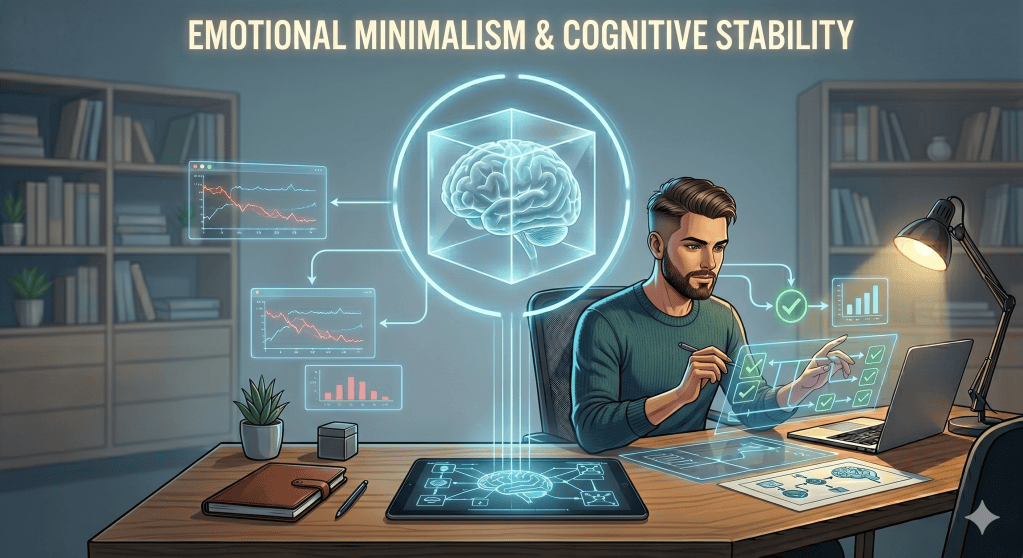
Emotional minimalism and cognitive stability — exploring the psychology and neuroscience behind the growing impulse to limit emotional overload and protect mental clarity.
There’s a particular kind of exhaustion that doesn’t show up on any medical chart. It doesn’t come from working too many hours or sleeping too few. It arrives after a long day of being emotionally available — responding to texts, navigating tension at work, absorbing the ambient anxiety of the news cycle, managing other people’s feelings alongside your own. By early evening, you’ve made decision after decision, processed dozens of emotional signals, and your capacity for further engagement has quietly collapsed.
This isn’t weakness. It’s the predictable outcome of a nervous system operating under conditions it was never designed to handle indefinitely.
The years following 2020 pushed this dynamic into sharper relief than any period in recent memory. A global pandemic, sustained social upheaval, economic instability, and the relentless scroll of algorithmically amplified outrage created a psychological environment unlike anything most people had experienced. The emotional demands were extraordinary. And the cultural response, when it eventually arrived, was telling: millions of people began pulling back, simplifying, and quietly restructuring their inner lives in ways that prioritized stability over engagement.
What emerged — sometimes called emotional minimalism — wasn’t a formal movement or a branded wellness trend. It was an organic adaptation. And understanding it requires looking at both the psychology driving it and the science that helps explain why it works.
The Cognitive Cost of Too Much Feeling
To understand emotional minimalism, it helps to first understand what excessive emotional engagement actually costs the brain.
Psychologists and neuroscientists have long known that emotions aren’t free. Every emotional experience involves physiological activation — hormonal shifts, changes in heart rate, alterations in the prefrontal cortex’s ability to regulate behavior. These responses evolved to help us respond to meaningful events, and they do that job well. The problem is that the modern information environment treats almost everything as a meaningful event.
Research on what psychologists call emotional labor — the work of managing your feelings to meet social expectations — has found that sustained emotional regulation depletes cognitive resources in measurable ways. Roy Baumeister’s ego depletion research, while controversial in its specifics and subject to significant debate in the replication literature, pointed to something that many people recognize intuitively: making yourself feel or not feel things takes energy, and that energy comes from a finite pool.
More recent and better-replicated work has focused on something called allostatic load — the cumulative physiological toll of chronic stress and emotional arousal. Research by Bruce McEwen and others at Rockefeller University demonstrated that prolonged activation of the body’s stress systems doesn’t just feel bad; it is associated with structural changes in the hippocampus, the amygdala, and the prefrontal cortex — precisely the regions involved in memory, emotional regulation, and decision-making. The implication is significant: environments that keep us in a state of chronic emotional activation may influence the very neural systems we rely on to cope with that activation.
When the Amygdala Drives
The amygdala — two small, almond-shaped clusters deep in the brain — is famously associated with emotional processing, particularly fear and threat detection. Under normal conditions, the prefrontal cortex exercises a kind of regulatory oversight over the amygdala, moderating its reactivity and allowing for more considered responses. Under stress, that relationship shifts. The amygdala becomes more reactive and the prefrontal cortex less effective, a dynamic sometimes described informally as “amygdala hijack,” a term coined by psychologist Daniel Goleman.
This isn’t just a metaphor. Neuroimaging studies have consistently shown that emotional threat — including social threat, which is what much of our digital media landscape delivers — activates the amygdala in ways that reduce the quality of higher-order cognition. We become faster to react, slower to reflect, and more likely to make decisions based on emotional salience rather than careful reasoning.
Emotional minimalism, at its functional core, is a set of practices and choices that deliberately reduce unnecessary amygdala activation. It’s not emotional suppression. It’s more like clearing the deck so that genuine emotional responses — to things that actually matter — can register clearly and be processed well.
What Emotional Minimalism Actually Is
The term itself resists precise definition, which is part of what makes it interesting to examine. Emotional minimalism isn’t a therapy protocol or a self-help system with trademarked steps. It’s better understood as a disposition toward emotional life that borrows its organizing principle from the broader minimalist philosophy: that less, chosen carefully, is more functional than more, accumulated carelessly.
In practical terms, it tends to involve a few recurring themes. People who describe moving in this direction often talk about becoming more selective about what emotional content they consume — which news they follow, which conversations they enter, which social media environments they inhabit. They describe becoming more deliberate about which relationships receive their emotional energy and which conflicts they engage versus let pass. They talk about developing a higher threshold for what they allow to disturb their baseline state.
This is not the same as numbness, disengagement, or the kind of flat affect associated with depression. If anything, the goal is the opposite. By reducing the emotional noise, people report becoming more attuned to the signal — more present in conversations that matter, more genuinely moved by experiences worth being moved by.
Philosopher Albert Camus wrote about the absurd as the gap between human desire for meaning and the universe’s silence on the matter. Emotional minimalism, in a secular and psychological sense, might be read as a response to a different kind of gap: between the emotional demands the modern world places on us and the actual emotional bandwidth we possess. It’s an attempt to close that gap not by expanding capacity indefinitely but by exercising more deliberate judgment about what deserves capacity in the first place.
The Influence of Mindfulness Research
The scientific conversation most relevant here is the substantial body of research on mindfulness and its effects on emotional regulation. Over the past two decades, mindfulness-based interventions have accumulated a reasonably robust evidence base — with important caveats about effect sizes and study quality — suggesting that training in non-reactive awareness produces measurable changes in psychological well-being and, in some studies, in neural function.
What’s relevant to emotional minimalism isn’t the meditation practice itself but the underlying mechanism it trains: what researchers call psychological distance from one’s own emotional states. The capacity to observe a feeling without being immediately governed by it. This is sometimes called decentering or defusion in the clinical literature, and it’s a core component of both mindfulness-based therapies and Acceptance and Commitment Therapy (ACT).
Emotional minimalism, practiced informally by people with no exposure to these clinical frameworks, appears to be reaching for a similar target through different means.
The Social Context: Why This Emerged When It Did
Ideas don’t appear in a vacuum. The turn toward emotional minimalism as a recognizable cultural posture happened in a specific historical context, and understanding that context matters for evaluating the phenomenon accurately.
The decade between 2012 and 2022 saw an extraordinary escalation in what might be called the emotional intensity of public life. Social media platforms optimized for engagement created environments where outrage, grief, and moral urgency were not just expressed but systematically amplified — rewarded with attention in ways that made reactive emotional expression structurally advantageous.
Research on social contagion and emotional transmission is relevant here. Studies by James Fowler and Nicholas Christakis established that emotional states spread through social networks in ways that parallel the spread of behaviors like obesity or smoking. Emotional contagion — the tendency for people to unconsciously mimic and internalize the emotional states of those around them — had been documented in face-to-face settings for decades. What the social media era revealed was that this contagion could operate at population scale, nearly in real time, through digital networks.
The COVID-19 pandemic didn’t create these dynamics, but it concentrated and intensified them. Lockdowns removed many of the ordinary social buffers and physical outlets that help people regulate emotional arousal. Daily routines collapsed. Social isolation increased the psychological weight of digital environments as primary sources of social contact. And the pandemic itself — a genuine, sustained existential threat — elevated background anxiety in ways that primed people to be more reactive to additional emotional stimulation, not less.
The Burnout Epidemic as Diagnostic Signal
Burnout, as a construct, existed long before 2020. Psychologist Christina Maslach’s foundational research on the subject dates to the late 1970s and defined burnout as a three-dimensional syndrome involving emotional exhaustion, depersonalization, and reduced sense of personal accomplishment. It was originally studied primarily in high-demand helping professions: nurses, social workers, teachers.
By 2021, burnout research and reporting had exploded far beyond those professional contexts. The World Health Organization formally recognized burnout as an occupational phenomenon in its International Classification of Diseases in 2019. Surveys conducted during and after the pandemic’s acute phase found burnout rates elevated across industries, demographics, and geographies. What had once been understood as a condition of particular professional environments was now being discussed as a near-universal human experience.
This matters for understanding emotional minimalism because burnout, in its emotional exhaustion dimension, is essentially what happens when emotional reserves run to zero. The appeal of emotional minimalism — of deliberately conserving emotional resources, setting stricter limits on input, refusing to engage with every demand — can be read partly as a rational response to having observed or experienced burnout’s consequences.
It’s also worth noting what burnout does to cognition. Research consistently links severe emotional exhaustion to reduced working memory capacity, impaired executive function, and diminished capacity for empathy — the very qualities people are trying to deploy when they’re emotionally overextended. The irony is precise: pushing emotional engagement past sustainable limits produces exactly the kind of flat, detached responsiveness that emotional minimalism’s critics often attribute to the practice itself.
Cognitive Stability as a Goal
If emotional minimalism describes the orientation — a preference for calibrated, selective emotional engagement over reactive, indiscriminate engagement — then cognitive stability is the outcome it’s reaching toward.
Cognitive stability, in psychological terms, refers to the capacity to maintain coherent, directed thought in the face of competing demands for attention and processing resources. It’s the ability to stay focused, to keep track of what matters and why, to make decisions based on values and reasoning rather than whichever emotion happens to be loudest at a given moment. It’s related to but distinct from emotional stability, which typically refers to the absence of extreme mood fluctuations.
What makes cognitive stability particularly valuable — and worth pursuing deliberately — is its relationship to what psychologist Mihaly Csikszentmihalyi described as flow: the state of engaged, absorbed, skilled activity that most people identify as among their most satisfying experiences. Flow states, by definition, require a degree of cognitive stability. You can’t enter or sustain deep absorption in a meaningful task if your attention is constantly being pulled by unresolved emotional noise.
The attention economy, a term popularized by economist Herbert Simon and later developed by writers like Tim Wu and James Williams, is premised on the observation that human attention is a finite resource subject to competition. The implications for cognitive stability are significant. Every notification, every emotionally activated scroll, every micro-decision about whether to engage with a piece of digital content represents a small withdrawal from the attention reservoir. Over time, the cumulative effect is a kind of attentional fragmentation — the subjective experience of being constantly pulled in multiple directions, unable to fully settle into any one thing.
Neurological Correlates of Stability
Research on attention networks in the brain has become considerably more sophisticated in the past two decades. The work of Michael Posner and colleagues described three distinct attentional systems — alerting, orienting, and executive control — each with distinct neural substrates and behavioral functions. The executive control network, centered on the anterior cingulate cortex and the lateral prefrontal cortex, is responsible for the kind of deliberate, goal-directed attention that underpins cognitive stability.
What’s particularly relevant is how this system interacts with emotional arousal. Moderate arousal tends to enhance attention and cognitive performance — this is the familiar Yerkes-Dodson relationship, where some activation improves function. But high or chronic arousal tips the balance, flooding the executive attention system with competing signals and degrading the quality of deliberate, goal-directed cognition.
The practical takeaway isn’t complicated: managing your emotional environment is, in a meaningful neurological sense, managing your cognitive environment. The two aren’t separate systems that happen to interact occasionally. They’re deeply intertwined, and the quality of one directly affects the quality of the other.
Distinguishing Minimalism from Avoidance
Any honest treatment of emotional minimalism has to grapple with the obvious critique: isn’t this just avoidance? Isn’t pulling back from emotional engagement a way of refusing to deal with uncomfortable realities, one’s own psychological material, or the legitimate claims that other people and the world have on one’s attention?
This is a fair and important question. Clinical psychology is generally clear that emotional avoidance — the suppression, denial, or systematic sidestepping of emotional experience — is associated with worse long-term outcomes. Research on experiential avoidance, a core concept in Acceptance and Commitment Therapy, consistently finds that efforts to avoid or suppress unwanted emotional experiences tend to maintain and amplify those experiences over time. The white-bear paradox, named for Fyodor Dostoevsky’s famous observation and later studied experimentally by Daniel Wegner, describes how trying not to think about something tends to make it more intrusive, not less.
Emotional minimalism, if understood and practiced well, is not the same thing as emotional avoidance. The distinction lies in intentionality and selectivity. Avoidance is undiscriminating — it tries to keep emotional experience at bay generally. Minimalism, as a principled approach, involves becoming more discerning about which emotional inputs to actively engage with and which to decline, without suppressing one’s capacity for emotional response itself.
A useful analogy: dietary minimalism doesn’t mean not eating. It means eating less, more carefully chosen, with greater attention to quality. Someone practicing emotional minimalism isn’t trying to stop feeling. They’re trying to feel the right things — or more precisely, to not feel compelled to respond to every emotional stimulus the environment generates, while remaining genuinely available to what actually deserves their emotional attention.
The clinical literature also makes an important distinction between suppression — actively trying to stop a feeling from being experienced — and reappraisal, which involves changing the cognitive framing of a situation to alter its emotional impact. James Gross at Stanford has conducted extensive research showing that these two strategies have very different consequences. Suppression tends to increase physiological arousal while decreasing subjective emotional experience — the emotional material doesn’t go anywhere. Reappraisal, by contrast, modulates the emotional response at its source and tends to produce better outcomes across a range of measures.
Emotional minimalism is more closely aligned with reappraisal and with what the broader ACT framework calls defusion — the capacity to notice an emotional pull without automatically acting on it. It’s a posture of presence without reactivity, which is a genuinely different thing from absence.
The Relational Dimension
No psychological practice exists in a social vacuum, and emotional minimalism is no exception. One of the most persistent concerns raised about it — particularly in cultural commentary — is that an emphasis on protecting one’s emotional resources necessarily comes at the expense of relational availability. That choosing not to engage with every emotional demand is, functionally, choosing to be less present for other people.
This concern deserves more nuance than it usually receives. The assumption embedded in it is that more emotional availability is always better — that deeper relationships and stronger communities are built by maximizing emotional engagement rather than by calibrating it. Research on what psychologist Adam Grant calls giving without burning out suggests the opposite. His work on prosocial behavior distinguishes between giving that is generous and sustainable versus giving that is compulsive and self-depleting. The latter, he found, is associated with lower well-being and, paradoxically, with lower effectiveness as a contributor to others.
Relationship science offers a parallel insight. John Gottman’s decades of research on what makes relationships function well identified emotional flooding — the state of physiological overwhelm that makes constructive emotional engagement impossible — as one of the primary predictors of relationship deterioration. People who protect themselves from flooding through what Gottman calls self-soothing are, paradoxically, more available for effective emotional connection, not less.
The implication is that emotional sustainability and relational depth aren’t in opposition. A person who has preserved their emotional resources through selective engagement may be more genuinely present in their important relationships than someone who has diffused that availability across hundreds of low-stakes emotional transactions.
Forward: What the Turn Toward Stability Tells Us
The cultural turn toward emotional minimalism and cognitive stability didn’t happen because people became less empathetic or less connected to the world. It happened because a critical mass of people encountered the limits of their capacity for emotional engagement under conditions of sustained excess.
What’s notable, looking back from 2026, is how durable this orientation has proven. In the years following the pandemic’s acute phase, the broader conversation about attention, cognitive load, and emotional sustainability has matured considerably. The crude early-2010s optimism about hyperconnectivity — the assumption that more information, more social contact, and more emotional transparency were straightforwardly good — has given way to something more complicated and more honest. The design choices embedded in digital platforms, the effect of algorithmic amplification on emotional arousal, and the cognitive costs of continuous partial attention have become mainstream subjects of discussion in ways they simply weren’t a decade earlier.
Research in affective neuroscience, positive psychology, and behavioral science has continued to refine the picture. The evidence base for interventions targeting emotional regulation — mindfulness practices, cognitive reappraisal training, attentional control exercises — has grown more robust. And a growing number of researchers are turning their attention not just to individual-level practices but to the environmental conditions, particularly digital environments, that make those practices more or less necessary.
Emotional minimalism, as a lived response to those conditions, represents something more significant than a wellness trend. It represents a kind of collective renegotiation of the terms on which people participate in a world that makes extraordinary and continuous emotional demands. The question it implicitly poses — what is actually worth my emotional attention, and what am I choosing to let go — is one of the more important questions anyone can ask in an environment designed to make that distinction as difficult as possible.
Cognitive stability, the condition that careful emotional management makes possible, is not a passive state. It’s the ground from which clear thinking, genuine connection, and purposeful action become possible. And in a period defined by its persistent tendency toward overwhelm, the deliberate cultivation of that ground may be one of the more consequential things a person can do.









