
Originally published in February 2023 and comprehensively updated/edited in June 2026.
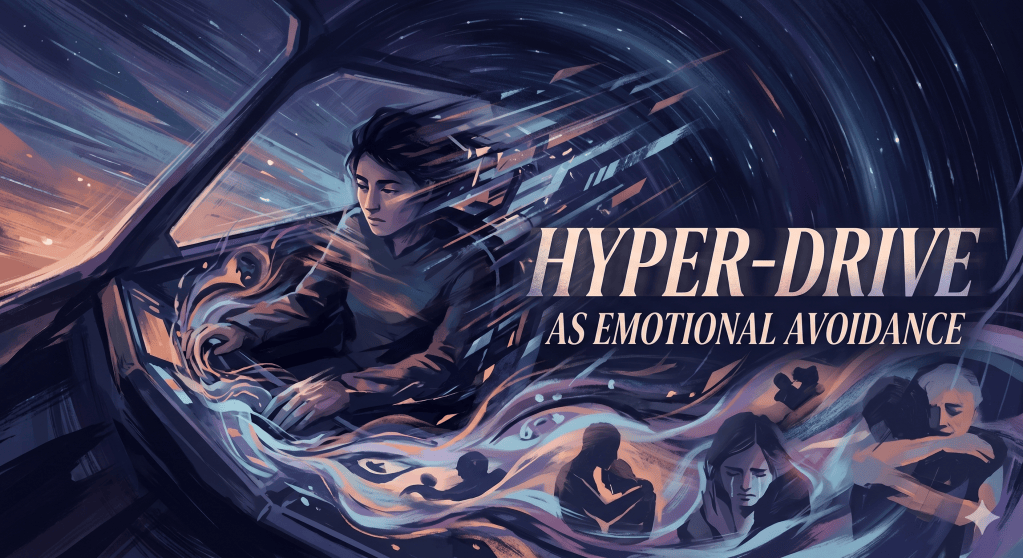
Hyper-drive as emotional avoidance explains how chronic busyness can become a way to escape grief, anxiety, and self-reflection — and what it costs over time.
There is a certain kind of exhaustion that does not come from doing too little. It comes from doing too much, for too long, for the wrong reasons. Millions of people in the modern world have built lives structured almost entirely around motion — constant productivity, relentless scheduling, a calendar packed so tight that silence feels like a malfunction. From the outside, this looks like ambition. From the inside, it often feels like survival.
The concept of hyper-drive as emotional avoidance describes a recognizable pattern: using busyness, overwork, and compulsive productivity as a way to sidestep emotions that feel too large, too threatening, or simply too inconvenient to sit with. It is not laziness in disguise. It is often the opposite — a kind of driven, high-functioning avoidance that society tends to reward rather than question.
Understanding this pattern matters because it operates invisibly. Unlike substance use or other more obvious forms of avoidance, chronic busyness carries cultural prestige. It gets promoted, praised, and LinkedIn-endorsed. The person grinding through 70-hour weeks, always reachable, always producing, looks like a success story — and may genuinely believe they have become one. The cost accumulates quietly, in the nervous system, in relationships, and in the gradual erosion of the capacity to simply be.
This essay examines the psychological architecture of hyper-drive avoidance: where it comes from, what it is actually avoiding, what neuroscience reveals about why busyness feels so much safer than stillness, and what the broader cultural forces are that have made this pattern so common and so difficult to recognize.
The Psychology of Staying Busy
Avoidance as a Coping Strategy
Avoidance is one of the most fundamental psychological responses available to human beings. When something hurts, feels dangerous, or threatens to overwhelm us, the impulse to move away from it is almost reflexive. This is not a flaw in human design. In genuine danger, avoidance saves lives.
The problem emerges when the avoidance machinery gets applied to internal experiences — emotions, memories, grief, anxiety, existential discomfort — that cannot actually be outrun. Psychological research has long recognized that experiential avoidance, the tendency to suppress, escape, or distract from unwanted inner experiences, is a significant driver of mental health difficulties. The landmark work associated with Acceptance and Commitment Therapy, developed by psychologist Steven C. Hayes and colleagues in the 1980s and 1990s, demonstrated that the effort to avoid or suppress painful inner states often paradoxically intensifies them over time.
Busyness fits neatly into this category. It is a particularly elegant avoidance strategy because it is constant, socially sanctioned, and comes with its own reward system. Unlike sitting alone with difficult feelings, staying busy produces tangible outputs: finished projects, answered emails, checked boxes. The feedback loop is immediate and reinforcing. The grief, the loneliness, or the low-grade dread that busyness is holding at bay gets no such feedback loop. It just waits.
What Is Actually Being Avoided
The emotional content that hyper-drive avoidance tends to suppress varies from person to person, but certain themes recur with enough frequency to be worth naming. Grief is one of them. Unprocessed loss — whether from bereavement, relationship endings, or the quieter losses of opportunity and time — has a stubborn way of persisting until it receives attention. Many people discover, often by accident during a forced slowdown, that underneath the busyness there is a profound sadness they have been too busy to feel.
Anxiety is another. Not the acute, situational kind that arises in a specific crisis, but the ambient, formless variety that does not have a clean object. Keeping busy offers a kind of structuring of the nervous system. As long as there is a task, there is something to orient toward. The moment the tasks run out, the unstructured anxiety floods back in, which is part of why so many people find weekends and vacations paradoxically more stressful than weekdays.
Existential questions occupy another layer. Questions about meaning, direction, identity, and purpose tend to surface during stillness. For people who are uncertain about who they are outside of their productivity, or what their life adds up to beyond achievement, those questions can feel unbearable. Staying busy ensures those questions never quite get asked.
There is also shame. Particularly for people who grew up in environments where their value felt conditional on their performance or productivity, stopping can feel like exposure — as though the moment they stop producing, the inadequacy they have been quietly running from will finally catch up and be confirmed.
The Neuroscience of Busyness
Why the Brain Prefers Motion
The human brain is not neutral about busyness and stillness. It has distinct systems that respond differently to activity and rest, and understanding those systems helps explain why hyper-drive avoidance feels so natural and, in a specific sense, so good.
The dopaminergic reward system, centered on structures deep within the brain including the nucleus accumbens and ventral tegmental area, is activated by goal-directed behavior. When you identify a task, work toward it, and complete it, this system releases dopamine in ways that feel reinforcing and motivating. Checking items off a list triggers small, real neurochemical rewards. This is functional — it is how the brain encourages behaviors that have historically been productive for survival. But it also means that the hyper-productive person is, in part, chasing a neurochemical experience that has almost nothing to do with the objective value of what they are producing.
The brain’s default mode network, a set of interconnected regions that becomes active during rest, mind-wandering, and self-reflection, tells a complementary story. For most people, quiet, unstructured time activates this network. It is associated with daydreaming, thinking about the future, processing social relationships, and constructing a coherent sense of self. These are not trivial functions. But for people who are using busyness to avoid inner experience, the default mode network tends to surface exactly the material they are trying to outrun. Research has linked heightened default mode activity with rumination, self-critical thought, and the intrusion of emotionally charged memories. For the avoidance-driven person, rest does not feel refreshing. It feels like a threat.
This creates a vicious cycle. The more someone uses activity to suppress uncomfortable inner states, the more those states accumulate and intensify, which makes rest feel even more threatening, which drives more frantic activity. The neurological underpinnings of stress also matter here: chronic activation of the sympathetic nervous system — the fight-or-flight branch — maintains a physiological baseline that makes stillness feel both unfamiliar and physiologically uncomfortable. The body becomes calibrated to motion.
Stress, the HPA Axis, and Chronic Activation
The hypothalamic-pituitary-adrenal axis, usually referred to as the HPA axis, is the body’s central stress response system. When the brain perceives a threat, this cascade releases cortisol and other stress hormones that prepare the body for action. In short bursts, this is adaptive. In chronic states of overactivation — which extended busyness tends to produce — elevated cortisol becomes damaging to multiple bodily systems, including memory, immune function, cardiovascular health, and sleep.
What is particularly relevant to hyper-drive avoidance is that the HPA axis does not distinguish cleanly between external threats and internal ones. Unprocessed emotional pain, suppressed grief, chronic low-grade anxiety — these activate stress responses too. Research in the field of psychoneuroimmunology has established connections between emotional states, stress hormones, and immune function that would have seemed speculative a generation ago. The avoidance strategy that feels protective is, at the physiological level, keeping the stress response partially activated around the clock.
There is also the matter of sleep. Sleep is one of the primary windows during which the brain processes and consolidates emotional experience. The work of neuroscientist Matthew Walker and others has highlighted how REM sleep in particular appears to allow the brain to process emotionally charged memories in a way that reduces their emotional charge over time. Chronic overwork tends to shorten and disrupt sleep, which means that the very mechanism the brain uses to digest difficult experiences gets systematically compromised — further compounding the accumulation of unprocessed emotional material.
Cultural Context: How We Got Here
The Productivity Myth and Its Genealogy
The equation of busyness with worth has deep roots in Western culture. The moral weight of hard work — once grounded in religious frameworks around discipline and virtue — survived the secularization of those frameworks almost entirely intact. What changed was the justification; what remained was the pressure.
When labor was primarily physical and output was directly visible, working hard meant something specific. The cognitive economy that replaced it — where knowledge work produces outputs that are far harder to measure, where the workday has no natural boundary, and where the worker’s mind is their primary instrument — changed the nature of work profoundly, but the cultural glorification of busyness did not update accordingly. If anything, it intensified.
By the early twenty-first century, what the writer Brigid Schulte called the “busyness badge” had become a form of social currency. Being busy, or being seen as busy, communicated importance, relevance, and value. Responding to emails at midnight was proof of dedication. Taking a lunch break was slightly suspicious. Saying you were overwhelmed had become not a cry for help but a form of humble-bragging.
Technology’s Role in Perpetual Motion
The smartphone accelerated all of this dramatically. Before constant connectivity, the workday had edges. Leaving the office meant something. Now, for hundreds of millions of people, the work context collapses into a device that is almost always within arm’s reach. The cognitive and emotional boundaries that physical separation used to enforce largely vanished.
This matters for emotional avoidance in a specific way: the phone provides a nearly frictionless escape from any moment that begins to feel uncomfortable. A difficult conversation, an awkward silence, a quiet evening that starts to surface unwanted thoughts — all of these can be interrupted instantly by a notification, a scroll, a quick check of something. The result is a technological environment that makes the emotional avoidance pattern not just possible but automatic. You do not have to decide to avoid; avoidance happens in the half-second reflex before conscious choice enters.
The attention economy built on top of this infrastructure has been engineered, deliberately and at enormous cost, to exploit exactly these tendencies. Platforms designed to keep users engaged benefit from anything that makes disengagement uncomfortable, and the anxious, avoidance-prone person is in many ways an ideal user. Research into social media use has found correlations between heavy use and both anxiety and depression, though untangling the causal direction — whether distressed people use platforms more, or whether heavy platform use generates distress — remains complicated. What seems clear is that the technological environment and the psychological pattern of hyper-drive avoidance have evolved into something that reinforces each other.
Forced Stillness and What It Revealed
The COVID-19 pandemic offered an unplanned test of this argument. When the external structures that had scaffolded busyness — commutes, offices, social obligations — were suddenly removed, many people discovered that what they experienced was not rest but exposure. Mental health data from that period showed significant increases in anxiety, depression, and what the organizational psychologist Adam Grant called “languishing” — a flat, hollow sense of functioning without flourishing. For people whose psychological equilibrium depended on constant motion, forced stillness did not produce calm. It produced the material the motion had been keeping at bay. The pandemic has receded as an immediate frame of reference, but the dynamic it revealed — that enforced downtime can feel more threatening than overwork — remains as relevant as ever.
Recognizing the Pattern
The Signature of Avoidance-Driven Busyness
Not all busyness is avoidance. People are genuinely overloaded. External demands are real. Single parents working multiple jobs and caring for children are not avoiding their emotions; they are surviving structural conditions. The distinction matters.
The signature of hyper-drive as emotional avoidance tends to involve a few recognizable qualities. One is the discomfort of doing nothing, which is disproportionate to any realistic consequence. A person who cannot sit quietly for five minutes without feeling anxious, guilty, or compelled to check something is not responding to an external demand — they are responding to an internal one. Another is the resistance to taking time off even when it is available and reasonable. Vacation days that go unused, weekends spent working by choice, leisure time that feels somehow pointless — these patterns suggest that busyness is serving a function beyond productivity.
A third marker is the quality of busyness itself. Avoidance-driven activity tends to be frenetic rather than focused. It multiplies tasks rather than completing and resting. It generates a kind of motion that feels urgent but does not necessarily go anywhere. People in this pattern often describe feeling simultaneously exhausted and restless — tired from the activity but unable to stop, because stopping would require something they are not ready for.
Perhaps the most telling sign is what happens in the gaps. When the meeting cancels, when the flight is delayed, when the weekend opens unexpectedly — what arises in those unplanned spaces? For people using busyness as avoidance, what tends to arise is not relief. It is often anxiety, irritability, a vague but pressing sense of wrongness. The emotion that has been kept at bay by the motion starts to surface, and the reflex is to immediately fill the space again.
The Difference Between Flow and Flight
It is worth being careful here about a genuine distinction. There is a real psychological state, described by the psychologist Mihaly Csikszentmihalyi as “flow,” in which deep engagement with challenging work produces an experience of effortless absorption, satisfaction, and meaning. Flow is not avoidance. It is one of the most reliable sources of psychological well-being that researchers have identified. The person in genuine flow is not running from anything; they are running toward something.
The difference between flow and flight is felt more than it is calculated. Flow tends to be nourishing, to leave the person energized or peacefully tired, to have a relationship with the person’s genuine values and interests. Flight tends to produce a hollowness underneath the activity, a vague exhaustion that does not resolve with more work, and an aversion to any activity that does not maintain the outward pace.
A person can also move between the two. Much work begins in genuine engagement and, over time, becomes increasingly driven by the underlying anxiety and avoidance. Recognizing the shift requires the kind of honest self-examination that hyper-drive avoidance is specifically designed to prevent.
The Path Through, Not Around
Why Slowing Down Feels Dangerous
The resistance to slowdown in people using busyness as emotional avoidance is not irrational, from the inside. It feels genuinely dangerous to stop. And in a limited, psychological sense, it is: slowing down means the avoided material becomes harder to ignore. The grief, the anxiety, the unasked questions — they don’t disappear while busyness keeps them muffled. They wait with patience.
This is where the psychological literature on emotional processing becomes relevant. Research in areas ranging from grief therapy to trauma-informed care consistently points to the same conclusion: avoided emotional experience does not diminish through avoidance. It accumulates. Some therapeutic frameworks describe this as a backlog of unprocessed feeling that builds up when a person consistently deflects inner experience rather than moving through it.
The evidence suggests that emotional processing, while uncomfortable, tends to produce resolution in ways that avoidance does not. This does not mean that people need to schedule a breakdown or manufacture catharsis. It means something more ordinary: that regular access to one’s own inner life — through therapy, through honest conversation, through journaling, through practices like meditation that train the capacity to observe rather than flee — gradually reduces the backlog and lowers the pressure that drives compulsive motion.
Therapeutic approaches with strong evidence bases — including Acceptance and Commitment Therapy, Cognitive Behavioral Therapy, and various emotion-focused approaches — generally work in part by increasing a person’s capacity to tolerate and observe their inner experience without immediately acting to eliminate it. This is sometimes described as increasing “distress tolerance,” but a more precise description might be: learning that the feeling will not kill you, and that you can survive the encounter with your own emotional life.
The Cultural Shift That May Be Underway
By the mid-2020s, there were signs — modest but real — that the cultural conversation around busyness and productivity was beginning to shift. The “quiet quitting” discourse of 2022, whatever its limitations as a term, reflected a genuine renegotiation happening in many workplaces between the old compact (total dedication in exchange for security and advancement) and a newer, more skeptical relationship to work as identity. The four-day workweek experiments that gained traction in multiple countries produced data suggesting that, under the right conditions, working less produced comparable or better output while measurably improving well-being.
None of this amounts to a revolution. The structural forces that produce overwork — economic precarity, competitive labor markets, algorithmic management systems, attention-economy incentives — have not dissolved. But the fact that concepts like “rest as resistance” and “doing nothing” (philosopher Jenny Odell’s book on strategic disengagement became a genuine cultural touchstone in the early 2020s) found substantial audiences suggests that a meaningful number of people recognized the problem this essay describes, even if they did not have language for it.
Conclusion: What It Costs to Never Stop
Hyper-drive as emotional avoidance is a pattern with a logic to it. It makes sense in the way that many coping strategies make sense: it works, up to a point, in the short term, at a cost that accumulates quietly in the background.
What it costs, ultimately, is access to one’s own life. Not the calendar version — the version filled with obligations and outputs and accomplishments — but the inner version, the one where the real texture of experience lives. The capacity for genuine rest, for sustained relationships, for grief that runs its course and becomes something else, for the slow accumulation of self-knowledge that is only possible when a person spends enough time in their own company to actually meet themselves.
The emotions being outrun require, eventually, the attention they have been waiting for. That is not a comfortable conclusion. But it is, for the people who recognize themselves in this pattern, a useful one. The frantic motion is not a sign of strength. It is often a sign of something that has not yet been given the chance to be known.
The path forward is not necessarily stillness for its own sake, or the abandonment of ambition, or a wholesale rejection of productivity. It is, more modestly, the development of a life in which motion and rest are both chosen rather than compelled — in which a person can work with focus and rest with ease, without one being a flight from the other.
That kind of life requires knowing what you are actually running from. Which means, at some point, being willing to stop long enough to find out.









