
Originally published in October 2023 and comprehensively updated/edited in June 2026.
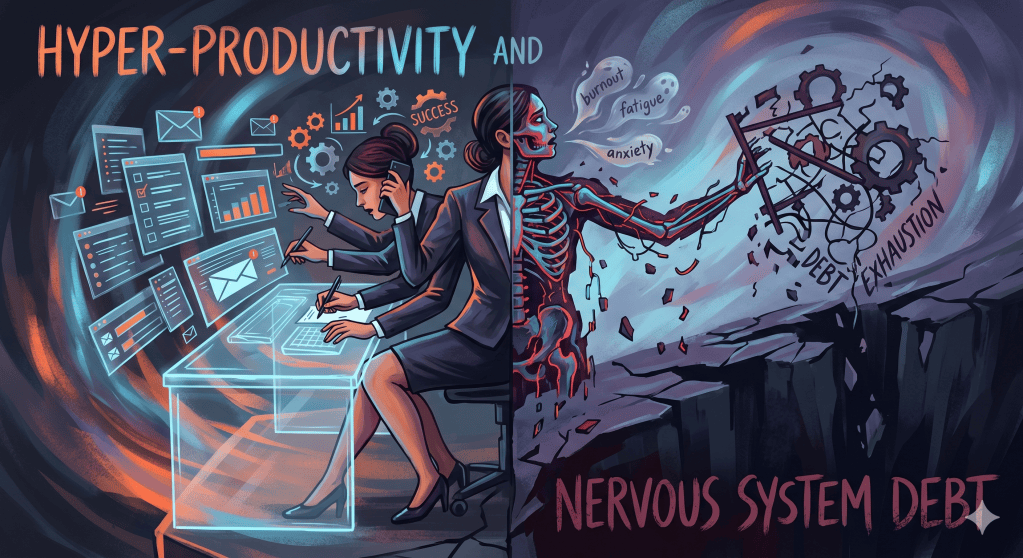
Hyper-productivity culture carried a hidden physiological cost. Here’s what neuroscience says about chronic stress, nervous system debt, and what recovery actually requires.
Hyper-Productivity and Nervous System Debt
There was a particular kind of exhaustion that became familiar to a lot of people in the years following the pandemic. It wasn’t simple tiredness — the kind that a good night’s sleep could fix. It was something deeper: a flatness, a sense of running on fumes even after rest, a difficulty feeling motivated by things that once mattered.
People described it in different ways. Some called it burnout. Some blamed their jobs, their schedules, the news cycle.
Some just said they felt broken.
What many of them were experiencing had a biological dimension that didn’t get much attention in the cultural conversation about productivity and mental health. The problem wasn’t just psychological. It wasn’t just about working too many hours or failing to take vacations. For a significant number of people, the nervous system itself had been pushed into a state of chronic dysregulation — a condition researchers sometimes describe using the concept of “nervous system debt,” a kind of accumulated physiological cost that the body eventually presents as a bill.
Hyper-productivity culture, which reached a kind of cultural apex in the early 2020s, played a meaningful role in this. Understanding how requires looking at what that culture actually was, what it asked of the human body and brain, and what decades of research in neuroscience, stress physiology, and behavioral science can tell us about the consequences of living permanently at full throttle.
The Rise of the Optimization Mindset
The cultural pressure to maximize personal output didn’t emerge from nowhere. It had been building for decades, accelerated by the internet, and then turbocharged by social media’s ability to broadcast individual achievement in real time. By the mid-2010s, a whole ecosystem of content had grown up around the idea that your waking hours were resources to be managed, that sleep was a variable to optimize rather than a biological necessity, and that the distance between where you were and where you wanted to be was primarily a function of how hard you were willing to grind.
The language of this culture was borrowed from software and business. People talked about “hacking” their productivity, “scaling” their habits, running themselves like startups. The underlying assumption was that the human being was essentially a system — one that could be endlessly tweaked and improved if only the right inputs were applied.
This wasn’t entirely without merit. Some of the research that got filtered into productivity culture was genuine. Studies on habit formation, deliberate practice, sleep and cognitive performance, and the psychology of motivation had real findings worth knowing. The problem wasn’t the research. It was how the culture absorbed and distorted it — stripping away nuance, ignoring individual variation, and transforming evidence-based insights into a moral framework in which maximum output became a virtue and rest became a character flaw.
By the time the pandemic arrived in 2020, this framework was deeply embedded in how many people — particularly younger professionals and knowledge workers — thought about themselves and their time.
What the Pandemic Did to an Already Stressed Population
The COVID-19 pandemic didn’t create hyper-productivity culture, but it did something interesting to it. For many people, it simultaneously increased the pressure to perform and removed the physical and social structures that had previously provided natural breaks from work. The commute disappeared. The office, with its ambient social rituals, disappeared. The clear boundary between professional and personal space collapsed.
Some people responded to this collapse by working more than they ever had. Remote work, for all its genuine advantages, also meant that the laptop was always there, on the kitchen table, in the bedroom. The workday had no edges. And in an environment where economic anxiety was high and layoffs were visible, many people felt that working harder was a rational response to uncertainty.
At the same time, another group — particularly people in caregiving roles, in frontline positions, or simply living through prolonged social isolation — experienced a different kind of overload. Not the overload of doing too much, but of coping with prolonged stress with few of the normal recovery mechanisms available. No in-person social connection. No travel. No concerts, restaurants, gyms, or any of the dozens of small experiences that function, in ordinary life, as nervous system resets.
Both groups, in different ways, were accumulating what researchers would recognize as allostatic load — a term from stress physiology that refers to the cumulative wear and tear on the body and brain that results from chronic stress activation.
This experience varied substantially across occupations and socioeconomic groups. The hyper-productivity narrative — the language of optimization, output metrics, and personal branding — was most visible among knowledge workers and the professional class, the people with laptops and Slack channels and performance reviews. But chronic stress and nervous system overload appeared across a much wider range of working life, often for entirely different reasons. Tradespeople faced physical demands and unpredictable schedules. Manufacturing workers operated under surveillance and production quotas. Healthcare workers absorbed not just workload but moral injury and secondhand trauma. Service-sector employees dealt with economic precarity, customer-facing stress, and the particular exhaustion of jobs that require sustained emotional performance. The mechanisms differed, and so did the cultural framing, but the physiological toll had common threads. What follows focuses heavily on knowledge-work culture because that’s where the productivity ideology was most explicitly articulated — but the underlying biology is not exclusive to any sector.
The Biology of Stress: What Happens When the System Never Rests
To understand nervous system debt, it helps to know something about how the stress response actually works.
The autonomic nervous system — the part of the nervous system that regulates involuntary functions like heart rate, digestion, and breathing — operates through two main branches. The sympathetic nervous system is responsible for the well-known “fight-or-flight” response. When the brain perceives a threat, the sympathetic branch activates: heart rate accelerates, blood is redirected to large muscles, cortisol and adrenaline flood the system, and non-essential functions like digestion are temporarily suppressed. The parasympathetic nervous system, sometimes called the “rest and digest” system, does the opposite. It brings the body back to baseline, facilitates recovery, and supports the biological processes — including immune function, tissue repair, and memory consolidation — that can only happen when the body is in a state of relative calm.
Under normal circumstances, these two systems work in dynamic balance. Stress activates the sympathetic branch. Resolution of the stressor allows the parasympathetic branch to restore equilibrium. The problem arrives when the stressor never fully resolves — or when the perception of threat is continuous.
Modern hyper-productivity culture is, in a very real physiological sense, a sustained threat environment. The to-do list never empties. The inbox refills within hours of being cleared. Deadlines stack. Social media provides a constant stream of other people’s achievements against which one can unfavorably compare one’s own output. The cognitive interpretation of all of this — I’m behind, I’m not doing enough, I need to work harder — keeps the sympathetic nervous system in a state of low-level chronic activation.
The HPA axis — the hypothalamic-pituitary-adrenal axis, the primary hormonal stress-response system — responds accordingly, maintaining elevated cortisol levels for extended periods. In the short term, cortisol is useful. It sharpens attention, mobilizes energy, and helps the organism deal with acute challenges. But chronically elevated cortisol has a very different profile of effects. Research has associated it with impaired memory and learning (particularly through its effects on the hippocampus), disrupted sleep architecture, suppressed immune function, increased cardiovascular risk, and changes to prefrontal cortex function that affect decision-making, impulse control, and emotional regulation.
This is what “nervous system debt” refers to in practical terms: the accumulated physiological cost of running the stress response chronically, without sufficient recovery periods, over months or years.
Why Burnout Isn’t Just Feeling Tired
The concept of burnout has been in clinical and organizational psychology since the 1970s, when researcher Herbert Freudenberger first used the term to describe the emotional exhaustion he observed in healthcare workers. Christina Maslach later developed the most widely used framework for understanding it, identifying three core dimensions: emotional exhaustion, depersonalization (a kind of emotional detachment from one’s work and the people it involves), and a reduced sense of personal accomplishment.
What’s important to understand is that these aren’t just feelings. They have neurobiological correlates. The emotional exhaustion of burnout looks, at the physiological level, like a system that has depleted its capacity to mount an effective stress response — not because stress has diminished, but because the machinery for managing it has worn down. Some researchers describe a pattern in which the early stages of burnout are characterized by hyperactivation (the revved-up, anxious, can’t-slow-down state many people recognize from periods of intense work), while later stages show a kind of blunted or flattened response — the system has, in effect, given up trying to keep up.
This is part of why people in deep burnout often struggle to recover simply by taking time off. The nervous system doesn’t reset the way a phone does when you restart it. Recovery from significant allostatic load is a biological process that requires time, safety, adequate sleep, physical movement, social connection, and the genuine absence of ongoing threat — not just a long weekend.
The cultural narrative around burnout has tended to frame it as a productivity problem: burnout is bad because burned-out people can’t work effectively. While that’s true, it understates what’s actually happening. Burnout is a health condition. Its effects extend well beyond work performance into physical health, relationships, cognitive capacity, and overall quality of life.
The Attention Economy’s Role in Nervous System Dysregulation
Hyper-productivity culture didn’t operate in isolation. It was amplified — and in some ways created — by the digital attention economy: the system of platforms, algorithms, and business models that compete for human attention as a commodity.
The smartphone, by 2023, had become a device that most people interacted with hundreds of times per day, often without conscious intention. Social media platforms were engineered to exploit reward-learning mechanisms and variable-reward reinforcement patterns associated with dopamine signaling. Notifications interrupted sustained focus repeatedly throughout the day. The news cycle delivered a constant stream of alarming information. And productivity-focused content on platforms like YouTube, TikTok, and Instagram held up idealized versions of output and achievement that functioned as social comparison triggers.
Each of these elements, individually, might be manageable. Together, in the context of a culture that already prized busyness as a status signal, they created an environment of near-continuous low-level arousal. The nervous system was being asked to process an enormous volume of stimulation and social information, much of it carrying implicit threat signals — competition, scarcity, inadequacy — while simultaneously maintaining the cognitive performance required for demanding knowledge work.
Research on attention and cognitive load helps explain some of the consequences. The prefrontal cortex, which supports executive functions like planning, decision-making, and sustained attention, is particularly sensitive to the effects of stress and fatigue. When the system is chronically taxed, prefrontal function degrades — people become more reactive and less reflective, more susceptible to distraction, less capable of the deep, sustained focus that complex work requires. Paradoxically, the more relentlessly someone pursues productivity under these conditions, the less productive their cognition tends to become.
Polyvagal Theory and the Window of Tolerance
In the 1990s, neuroscientist Stephen Porges developed what he called polyvagal theory — an expanded model of autonomic nervous system function that has had significant influence in clinical psychology, trauma therapy, and popular wellness conversations. Porges proposed that the autonomic nervous system operates through a hierarchy of states: a ventral vagal state associated with social engagement, curiosity, and felt safety; sympathetic activation (fight or flight) under perceived threat; and, under conditions of overwhelming or inescapable threat, a deeper dorsal vagal state associated with shutdown, dissociation, and the flat numbness that many people in severe burnout describe.
Polyvagal theory remains a subject of some scientific debate — critics have questioned some of Porges’ anatomical claims — but its clinical utility has been widely recognized. And its core insight maps onto what stress researchers have documented for decades: the human nervous system has a “window of tolerance,” a zone within which learning, connection, and effective functioning are possible. Outside that window — whether through over-arousal or under-arousal — both performance and wellbeing degrade significantly. Hyper-productivity culture, by keeping people in a state of chronic sympathetic activation with insufficient recovery, systematically narrows that window over time.
What Recovery Actually Requires
One of the most significant gaps between popular productivity culture and actual science has been on the question of recovery. The productivity content ecosystem has generally framed recovery as a tool for better performance — sleep hacks, meditation apps, and “strategic rest” were all presented primarily as means to greater output. This framing isn’t entirely wrong, but it misunderstands the nature of what the nervous system actually needs.
Genuine nervous system recovery isn’t a productivity strategy. It’s a biological process — and it’s commonly misunderstood. Recovery is not the absence of activity. Physiologically, recovery means spending enough time in states that allow the nervous system to shift out of threat monitoring and back into regulation. That distinction matters because plenty of activities people use to “decompress” — scrolling social media, watching anxiety-inducing news, ruminating about tomorrow’s workload — don’t produce regulation even when they feel passive. The nervous system doesn’t relax because the body is still. It relaxes when the brain’s threat-detection systems receive sufficient signals of safety.
Research suggests those signals are produced by consistent and sufficient sleep (the single most important recovery mechanism the body has); physical movement, which reduces cortisol, supports hippocampal neurogenesis, and improves emotional regulation; genuine social connection — not social media, but face-to-face contact, which reliably activates the ventral vagal system; time in natural environments, associated with measurable reductions in stress hormone levels and improved attentional capacity; and periods of genuine mental disengagement that support the default mode network activity essential for creativity, self-understanding, and emotional processing.
None of these are novel. The research has been pointing in this direction for years. What was novel, in the cultural context of the early 2020s, was the degree to which people’s environments actively worked against all of them — and the degree to which the cultural narrative encouraged people to interpret the need for these things as weakness rather than biology.
The Quiet Pushback
By late 2023, something was beginning to shift. The phrase “quiet quitting” — which had emerged in 2022 to describe employees choosing to do their jobs without going above and beyond — had largely been replaced by more nuanced conversations about sustainable work and the limits of self-optimization. A backlash against hustle culture, which had been building for years on the margins, was beginning to reach the mainstream. Former productivity influencers were publicly describing their own burnout experiences. Research on the four-day work week was gaining attention. The concept of rest as a legitimate human need — not a reward for sufficient productivity, but a baseline requirement — was finding a broader audience.
This wasn’t a clean cultural reversal. Hyper-productivity norms remained deeply embedded in many industries and organizational cultures, and economic pressures that drive overwork hadn’t disappeared. But there was a growing recognition, at least in some quarters, that the optimization mindset had costs that hadn’t been adequately accounted for — and that some of those costs were being paid by the nervous system in ways that weren’t immediately visible but were, over time, very real.
The Longer View
The story of hyper-productivity culture and nervous system debt is, in one sense, a story about a mismatch. Human physiology evolved over hundreds of thousands of years for a world that looked nothing like early 21st-century knowledge work. The stress response evolved to handle acute, physical threats that resolved quickly. The social instincts that make status and comparison so powerful evolved in small communities where social information was genuinely important for survival. The brain’s capacity for rumination and future-planning evolved in contexts where that kind of mental rehearsal had clear survival value.
None of this evolved for sitting in front of screens for ten hours a day, monitoring a continuous stream of social comparison content, processing hundreds of notifications, and trying to maintain cognitive performance under conditions of chronic sleep insufficiency and social isolation. The mismatch between the environment we evolved for and the environment many people now inhabit is real, and its effects on the nervous system are measurable.
This doesn’t mean that modern work is impossible or that people can’t adapt. Humans are enormously flexible, and the capacity for culture and deliberate behavior change means we’re not purely at the mercy of our evolutionary history. But it does mean that the costs of ignoring basic biological requirements for recovery aren’t optional — they accumulate, and eventually they surface in ways that are hard to ignore.
The concept of nervous system debt offers a useful frame for understanding this. Just as financial debt accumulates when spending consistently exceeds income, physiological stress debt accumulates when demand consistently exceeds recovery. And just as financial debt has to be repaid eventually — with interest — the body eventually presents its bill. The body can tolerate extraordinary demands for surprisingly long periods, but it never stops keeping accounts.
The question that the cultural moment of the mid-2020s was beginning to grapple with was not whether that bill could be avoided, but whether it was possible to redesign the systems — organizational, technological, cultural — that had been generating it so reliably for so long.









