
Originally published in May 2024 and comprehensively updated/edited in June 2026.
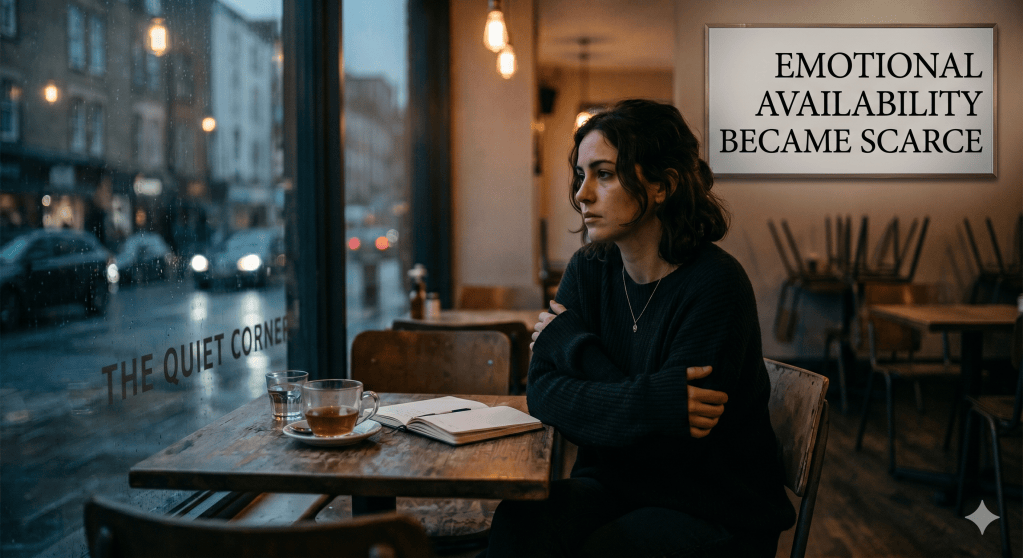
How emotional availability became scarce in the early 2020s — the psychology, neuroscience, and social forces behind a generation struggling to truly connect.
There’s a particular kind of loneliness that doesn’t announce itself. It doesn’t arrive when you’re sitting alone on a Friday night or when you haven’t spoken to another person in days. It shows up in the middle of a conversation — when you’re talking to someone who is technically present, physically there, maybe even looking at you — and you can feel, with quiet certainty, that they are somewhere else entirely. They are managing something. Processing something. Protecting something. And whatever it is, it has taken up all the space where connection used to live.
This is what emotional unavailability looks like from the inside. And in the years surrounding 2024, it became something closer to the norm than the exception.
To say that emotional availability became scarce is not to make a sentimental argument about people being less kind or caring than they used to be. People were not necessarily meaner. They were overwhelmed. They were depleted. They had lived through a global pandemic, years of social and political fracture, an economic environment defined by instability, and a media ecosystem that rewarded outrage and anxiety above nearly everything else. They had also, in many cases, spent formative years communicating primarily through screens — a medium that is extraordinarily good at transmitting information and remarkably poor at transmitting the kind of sustained emotional presence that human beings actually need from one another.
The result was a population that, by many measurable indicators, was struggling to show up emotionally — for friends, for partners, for family, and often for themselves. What follows is an attempt to understand how that happened: the forces, internal and external, that pulled emotional availability out of everyday life and what that absence cost.
What Emotional Availability Actually Means
The term gets used loosely, so it’s worth pinning down what it actually refers to. Emotional availability is not the same as being emotionally expressive, or even emotionally intelligent. Someone can be articulate about their feelings, capable of great empathy in the abstract, and still be emotionally unavailable in the ways that matter most in a relationship.
Developmental psychologist Zeynep Biringen helped define emotional availability as a form of mutual attunement — a relationship in which both people remain accessible, responsive, and genuinely engaged with one another. Her research found that this quality of connection shapes attachment security, emotional regulation, and cognitive growth in ways that last well into adulthood.
The same basic architecture matters in adult relationships. When someone is emotionally available to you, they’re not just listening — they’re present in a way that allows them to notice what you’re actually communicating, including the things you’re not saying directly. They can tolerate your difficult emotions without shutting down or flooding you with their own. They can be close without being controlling. This sounds simple, but it requires a significant internal resource: the capacity to be present with someone else without being destabilized by what you encounter there.
That capacity, it turns out, is not infinite. And by the early-to-mid 2020s, for a great many people, it had been running low for a long time.
The Pandemic as a Rupture Point
Any serious account of emotional unavailability in this period has to begin with COVID-19 — not because the pandemic caused all of it, but because it accelerated and intensified dynamics that were already underway, and because the psychological damage it left behind was both widespread and poorly understood.
The evidence of widespread mental health deterioration during and after the pandemic is difficult to ignore. Depression and anxiety rates rose sharply in many countries during 2020. The World Health Organization estimated a 25 percent increase in anxiety and depressive disorders globally in the first year of the pandemic alone. Loneliness spiked sharply, particularly among young adults — a counterintuitive finding, given that young people are often assumed to be more socially resilient. Trauma responses were widespread, though often unrecognized as such.
But the less-discussed consequence was what the pandemic did to people’s capacity for emotional engagement itself. Sustained stress and uncertainty have well-documented effects on the nervous system. When the brain’s threat-detection systems are chronically activated — when you are living, month after month, with background-level fear about health, finances, and social stability — the neural resources available for complex social and emotional processing get redirected. This is not a metaphor. Neuroimaging research has shown that prolonged stress alters activity in the prefrontal cortex, the region most associated with empathy, perspective-taking, and emotional regulation. The brain under chronic stress is quite literally less equipped to do the work of emotional connection.
This is one reason why people who went through the pandemic often described a strange flattening of their emotional range — a reduced capacity not just for distress but for joy, for curiosity, for genuine interest in other people. Clinicians gave this various names: pandemic burnout, languishing, anhedonia. What all of these terms pointed toward was the same underlying reality: a population that had used up its reserves.
Burnout Beyond the Workplace
The word “burnout” entered common use as a workplace phenomenon. It described the specific exhaustion of people in high-demand professions — healthcare workers, teachers, social workers — who gave so much of themselves in their jobs that they had nothing left by the time they got home. But in the years following the pandemic, burnout spread well beyond any particular profession. It became something closer to a cultural condition.
Researchers at Maslach Burnout Inventory, who have studied occupational burnout for decades, identify three core components: emotional exhaustion, depersonalization (a kind of psychological detachment from others), and a reduced sense of personal accomplishment. What became apparent in post-pandemic research was that all three of these were showing up not just in workplaces but in personal relationships — in marriages, friendships, and family systems that had been put under sustained pressure for years.
Emotional exhaustion and emotional availability are essentially incompatible. When the internal bandwidth is gone, you find yourself going through the motions of connection — saying the right things, performing the expected responses — while some core part of you is behind glass, watching from a safe distance. Depersonalization compounds this: in its milder forms, it shows up as a withdrawal from intimacy, a reluctance to take the emotional risks that genuine closeness requires. People became more guarded. They were quicker to retreat into irony or deflection when conversations moved toward anything that felt genuinely vulnerable.
The Attention Economy and What It Did to Presence
Parallel to the trauma of the pandemic was a slower, quieter erosion — one that had been building for more than a decade and that the pandemic dramatically accelerated: the restructuring of human attention by digital technology.
This is not a technophobic argument. Smartphones and social media platforms have done things of genuine value, including connecting people who would otherwise be isolated and democratizing access to information and community. But alongside those benefits, the attention economy — the system by which digital platforms compete for and monetize human attention — has had some measurable effects on the internal landscape of the people who use it.
The most relevant finding for emotional availability is what researchers call “continuous partial attention” — a state described by former Apple and Microsoft executive Linda Stone, who noticed that many people in technology environments were never fully attending to anything. They were always monitoring multiple streams simultaneously, always half-listening for the next notification, the next update, the next signal from the ambient digital environment. This state is nearly the opposite of presence. And presence, as we’ve established, is the foundational ingredient of emotional availability.
Sherry Turkle at MIT documented this through years of interviews about technology and relationships. What she found was not that people loved technology more than they loved people, but that technology had restructured the contexts in which human conversation happened. People reported being less tolerant of conversational lulls, less willing to sit with ambiguity, more likely to reach for their phones when conversations became emotionally demanding. The phone, in those moments, functioned as an escape valve from the discomfort that genuine intimacy sometimes requires.
Loneliness as Both Cause and Consequence
There is a paradox embedded in this story. The period when emotional availability became most scarce was also, by most measures, one of the loneliest periods in recent history. You might expect the two to work against each other — that people, hungry for connection, would become more emotionally available, not less. But loneliness and emotional unavailability tend to reinforce each other in ways that trap people rather than liberate them.
Chronic loneliness, research has found, activates the brain’s threat-detection systems in ways that make people more hypervigilant in social situations, more sensitive to perceived rejection, and more likely to interpret ambiguous social signals as hostile. Paradoxically, people who are chronically lonely often become more socially withdrawn, not less — not because they don’t want connection, but because the fear of rejection or further disappointment feels too costly. The result is a kind of defensive unavailability: people protecting themselves from the very intimacy they need.
Social psychologist John Cacioppo, whose decades of research on loneliness are among the most rigorous in the field, described loneliness as a signal — analogous to physical pain — that something important is missing and that action is needed. But like physical pain that becomes chronic, loneliness, when sustained over long periods, stops functioning as a useful signal and starts functioning as a chronic condition that warps perception and behavior. Cacioppo’s work, and research that followed from it, helped establish that loneliness is not merely an emotional state but a physiological one, with measurable effects on immune function, sleep quality, cardiovascular health, and cognitive performance.
By the mid-2020s, a significant body of research was pointing toward something that would have seemed dramatic if it hadn’t become so commonplace: millions of people were living in a state of loneliness severe enough to have real consequences for their physical health. And they were doing so while often being more technically “connected” — through social media, messaging apps, and digital communities — than any generation in human history.
What Happened to Friendship
If intimate partnerships showed the strain of emotional unavailability most acutely, friendships showed something subtler but perhaps more telling about how the culture had changed. The pandemic had forced a kind of triage in social lives: people maintained only their closest relationships and let others quietly lapse. When social life resumed, many people found that they had, effectively, forgotten how to maintain peripheral friendships — the connections that are not intimate enough to be worth heroic effort but that, in aggregate, constitute much of the texture of a socially healthy life.
Sociologists refer to these as “weak ties” — a term coined by Mark Granovetter in the 1970s to describe relationships that are not deeply intimate but that serve important social functions. Think of the coworker you chat with over coffee, the neighbor you wave to on evening walks, the acquaintance you see reliably at a local coffee shop — people you’d never call in a crisis but whose presence quietly anchors your sense of belonging in the world. Weak ties expose you to new information, opportunities, and perspectives that your close circle can’t provide. When they erode, people experience a particular kind of social thinning: they may still have a few close friends, but the broader social fabric around them has become less dense, less varied, less sustaining.
This is precisely what happened for many people in the early 2020s. Weak ties were the first casualties of the pandemic’s social restrictions, and they proved surprisingly difficult to rebuild. Multiple surveys suggested that people reported having fewer close friendships than in previous decades, and that the friendships they had were often shallower or more sporadic.
The Therapy Boom and Its Limits
One of the more interesting cultural developments of this period was the explosion of interest in therapy, mental health awareness, and the vocabulary of psychological self-understanding. Therapy utilization reached historically high levels in many countries by the mid-2020s. The language of trauma, attachment theory, nervous system regulation, and emotional intelligence had moved from clinical settings into everyday conversation, relationship podcasts, and social media posts. In one sense, this was a genuine cultural achievement: the stigma around mental health treatment had decreased significantly, and people were more willing to name and discuss emotional experiences that previous generations might have suppressed.
But the therapy boom also had some less discussed complications. One was a potential gap between psychological self-awareness and relational capacity. None of this diminishes the value of therapy itself — rather, it highlights the difference between understanding oneself and sustaining connection with others. People became better, in many cases, at identifying and articulating their own emotional states — recognizing anxiety, naming triggers, understanding their attachment style — but these skills are not automatically translatable into emotional availability for others. Knowing that you are anxiously attached, for example, does not by itself make you more emotionally present in a relationship. The work of translating self-knowledge into relational change is significant, and it is work that many people were still very much in the middle of.
There was also a subtler dynamic: the framing of mental health in this period was often individualistic. The implicit message of much popular psychology was that the goal was to get your own emotional house in order — to regulate your own nervous system, process your own trauma, protect your own energy. These are legitimate and important aims. But they can, if pursued without careful attention, shade into a kind of emotional insularity — a focus on self-preservation that makes it harder, not easier, to be genuinely present and available to others.
The Science of Attunement and Why It’s Hard
One reason emotional availability is so difficult to maintain under pressure is that it requires a fairly sophisticated interplay of neural systems, and those systems are among the most sensitive to disruption by stress, fatigue, and chronic threat.
The concept of attunement — the ability to read and respond to another person’s emotional state in real time — is rooted in the functioning of what’s sometimes called the “social nervous system.” One influential framework for understanding this process is Polyvagal Theory, developed by neuroscientist Stephen Porges, which proposes that the autonomic nervous system plays a central role in social engagement. According to this model, when we feel safe, the nervous system supports facial expressiveness, vocal prosody (the musicality of speech), and the ability to listen and respond. When we feel threatened, those same systems shut down or become dysregulated, and our capacity for genuine social connection shrinks accordingly.
What this means is that emotional availability is not simply a choice or an attitude. It is, in part, a physiological state. A person whose nervous system is chronically in a mild or not-so-mild state of threat activation — and this describes a large proportion of people in the years following the pandemic — is, at the level of basic biology, less equipped for the kind of mutual attunement that emotional availability requires. You cannot simply decide to be more emotionally present if your nervous system has concluded, based on years of evidence, that the environment is not safe enough to drop your guard.
This is not an excuse. It is an explanation — and an important one, because it points toward what would actually need to change for emotional availability to be restored: not just individual effort or changed attitudes, but the material and environmental conditions that allow the nervous system to feel, at a basic level, that relaxing into connection is safe.
What Was Lost
The costs of widespread emotional unavailability are difficult to fully tally because so many of them are invisible — they show up in the texture of daily life rather than in easily measurable outcomes. They appear in conversations that go nowhere, in partnerships that slowly hollow out, in the accumulation of small moments when someone needed to be met and wasn’t.
But some costs are measurable. Research consistently shows that the quality of social relationships is one of the strongest predictors of mental health, physical health, and longevity. The Harvard Study of Adult Development, one of the longest longitudinal studies ever conducted, found that the quality of close relationships was a better predictor of late-life health and happiness than cholesterol levels, income, or social class. When emotional availability erodes at a population level, these health outcomes erode with it — not dramatically, but steadily, in the way that a slow leak eventually empties a tank.
Children were particularly affected. The research on how parental emotional availability shapes child development is extensive and sobering. Parents who were emotionally unavailable — not through malice or indifference, but through exhaustion, depression, anxiety, or distraction — raised children who showed measurable differences in attachment security, emotional regulation, and social competence. The pandemic generation of children grew up in households where adults were under extraordinary stress, often working from home in conditions of sustained anxiety, with reduced access to the social support networks that normally buffer parenting stress. The downstream effects of that will take years to fully understand.
A Forward-Looking Note
By the mid-2020s, there were signs of cultural recalibration — not dramatic reversals, but gradual adjustments. Mental health awareness had brought genuine, if imperfect, resources to people who had previously had none. Conversations about burnout, emotional labor, and the limits of individual coping capacity were becoming more mainstream. There was growing cultural pushback against the always-on ethos of the attention economy, with more people deliberately limiting their screen time and rebuilding offline social practices.
Some researchers were beginning to identify a post-pandemic shift in how people thought about relationships and community — a greater appreciation for presence, for locality, for the irreplaceable quality of being physically together with people you care about. Whether those shifts were deep enough or durable enough to meaningfully reverse the trends of the preceding years remained genuinely uncertain.
What was clear was that the problem of emotional availability was not merely a personal one to be solved through individual therapy or self-improvement. It was embedded in the structures of how people worked, how they consumed information, how they organized their lives. The conditions that depleted emotional availability — chronic stress, financial insecurity, information overload, the erosion of shared public life — were not going to be addressed by any single intervention. They required attention at multiple levels simultaneously.
The conversation that needed to happen — and that, gradually, was beginning to happen — was one that held both the individual and the systemic in the same frame: acknowledging the genuine difficulty of the conditions people were navigating while also recognizing that emotional availability, whatever its neurological and social underpinnings, remains something that human beings can and must find ways to cultivate. Not because it is easy. But because the alternative — a world in which people are increasingly technically connected and genuinely alone — is one that the evidence suggests no one actually wants to live in.
The scarcity of emotional availability in this period was real. But scarcity, unlike absence, implies that the resource still exists somewhere. The question was always how to find it again.









