
Originally published in June 2024 and comprehensively updated/edited in June 2026.
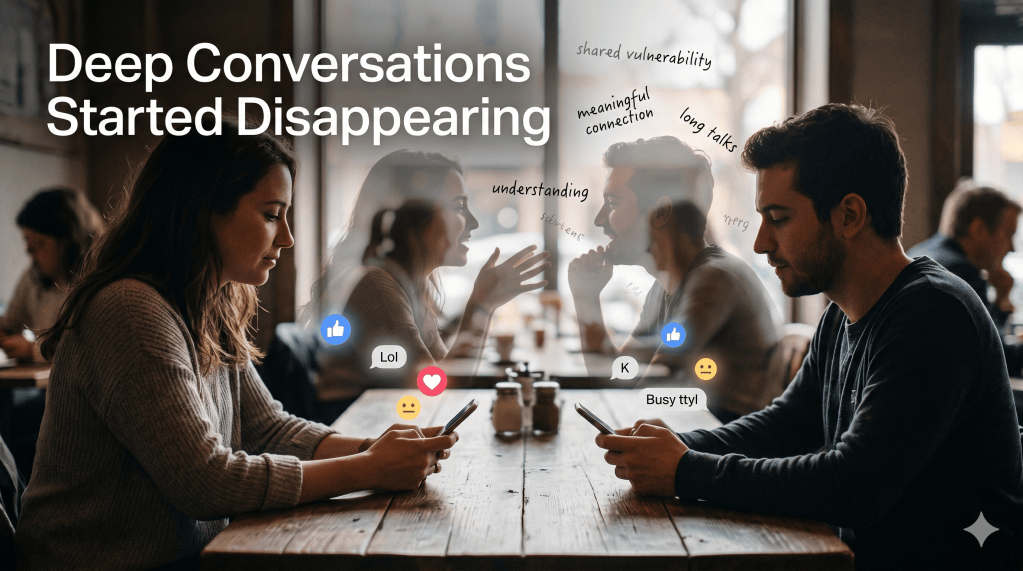
Deep conversations didn’t disappear overnight — they eroded through distraction, social media performance, rising polarization, and the structural decline of shared community space. Here’s the science of how it happened.
There’s a particular kind of silence that has nothing to do with noise. You can be at a dinner table with people you’ve known for years, phones face-down, conversation moving from one topic to the next — and still feel like nothing real was said. Nobody admitted anything. Nobody asked a question that mattered. The hour passed pleasantly, and you left knowing less about the people in the room than you did walking in.
This isn’t a new feeling, but at some point in the 2010s and into the 2020s, it started showing up with unusual frequency. Therapists noticed it in their clients. Researchers studying loneliness began separating two different kinds — the absence of people, and the absence of real contact with people. Writers puzzled over why so many conversations felt transactional, surface-level, almost performative. And ordinary people, without necessarily having words for it, recognized that something about how they talked to each other had changed.
Deep conversations — the kind where you say something true, where the other person responds with something true, where both of you leave the exchange slightly altered — didn’t vanish overnight. They eroded gradually, shaped by shifts in technology, culture, social psychology, and the structure of daily life. Understanding how that happened is more complicated than blaming a single cause, but the threads, once pulled, reveal something important about what human connection actually requires and why it became harder to maintain.
What “Deep” Actually Means
Before exploring what changed, it’s worth being precise about what’s actually being discussed. “Deep conversation” sounds like a vague self-help concept, but researchers have studied it with enough rigor to give it some definition.
A 2010 study by psychologist Matthias Mehl and colleagues at the University of Arizona found that people who reported higher levels of well-being spent significantly more time in substantive conversation and less time in small talk. Small talk, as Mehl defined it, meant exchanges about the weather, weekend plans, or superficial pleasantries — conversations where neither party reveals anything about their actual inner life. Substantive conversation, by contrast, involved sharing perspectives, personal experiences, values, or information with real meaning. The correlation between the two types and self-reported happiness was striking enough that Mehl described it as a meaningful finding, not a trivial one.
What makes conversation feel substantive isn’t simply its topic — you can have a serious-sounding exchange about politics that reveals nothing about either person — but its quality of mutual disclosure and genuine engagement. Psychologist Arthur Aron, best known for his research on intimacy, developed a set of questions in the 1990s designed to accelerate closeness between strangers. The mechanism was simple: gradually escalating self-disclosure, with both parties taking turns revealing progressively more personal information. The research showed that this kind of structured vulnerability could generate genuine feelings of closeness in under an hour. What the study quietly demonstrated was that deep conversation isn’t some mystical capacity reserved for old friendships. It’s a set of conditions — openness, reciprocity, time, and attention — that most people can enter when those conditions are present.
The question, then, is why those conditions became harder to sustain.
The Architecture of Distraction
The most obvious factor is the smartphone, but attributing the decline of deep conversation to phones alone is too simple. The more precise claim is that the mobile internet restructured attention in ways that make the conditions for substantive exchange harder to achieve.
Neuroscientist Adam Gazzaley and psychologist Larry Rosen, writing in The Distracted Mind, described the human brain as having evolved for goal-directed behavior in environments that didn’t bombard it with constant interruption. Our capacity for sustained attention is real but fragile. It requires a kind of protective mental space that the modern information environment actively erodes.
By the early 2010s, the average American was spending several hours per day on their phone, and research showed that even the presence of a phone on a table — not being used, just sitting there — reduced the quality of conversation between the people around it. A 2012 study by researchers at the University of Essex found that when a phone was visible during a conversation, participants reported lower levels of empathy and connection compared to conversations that took place with no phone present. The phone didn’t need to ring or light up. Its mere presence was enough to signal that the conversation might be interrupted, which subtly shifted how both parties engaged with each other.
This is worth pausing on. The distraction wasn’t even happening. The possibility of distraction was enough to change the emotional texture of the exchange.
Beyond the physical presence of devices, the platforms that ran on them were designed to keep attention fragmented. Social media feeds, notification systems, and the reward loops built into apps all operated on principles derived from behavioral psychology — variable ratio reinforcement, the same mechanism that makes slot machines compelling. The brain learns to anticipate the next update, the next message, the next reaction, in a way that makes extended, uninterrupted focus on any one thing feel unnatural.
Dr. Gloria Mark, a researcher at the University of California Irvine who has studied workplace attention for decades, found that it takes an average of over twenty minutes to fully return to a complex task after an interruption. Conversation isn’t exactly a “task,” but the cognitive demand of genuine engagement — tracking what someone is saying, formulating a thoughtful response, managing your own emotional reactions — requires sustained mental presence. When the habit of attention is interrupted constantly throughout the day, the mental muscle for deep engagement atrophies in subtle ways.
The Performance of Self
The attention problem intersected with something more sociological. Social media didn’t just distract people from their conversations; it changed the social logic governing how people thought about presenting themselves.
The sociologist Erving Goffman, writing in the 1950s, described social life as a kind of theater, where people manage their “front stage” presentation for audiences while keeping their more authentic selves backstage. This was always true to some extent, but the rise of platforms like Facebook, Instagram, Twitter, and later TikTok dramatically expanded the scale of front-stage performance. For the first time in human history, ordinary people were maintaining continuous public identities — profiles, timelines, carefully curated representations of who they were and what their lives looked like — visible to hundreds or thousands of people at once.
The psychological research on this shift is nuanced. Not all self-presentation on social media is dishonest, and some researchers found that platforms could support genuine connection under the right conditions. But the dominant pattern that emerged — particularly as platforms engineered their algorithms to reward emotionally polarizing or attention-grabbing content — was one in which people learned to present the most appealing, the most legible, or the most strategically positioned version of themselves.
This created a spillover effect into face-to-face interaction. When you spend significant portions of your day managing a public persona, the habits of performance become harder to switch off. Several researchers studying social anxiety in young adults noted a marked increase in what they called “self-monitoring” — the degree to which people evaluated their own behavior through the imagined lens of an audience. High self-monitors, as social psychologists call them, tend to be more socially skilled in superficial encounters but less capable of genuine intimacy, because intimacy requires a willingness to be seen without the performance.
The irony is that social media promised connection — and for many people, especially those in geographically isolated or socially marginalized circumstances, it genuinely delivered a form of it. But the style of connection it normalized was fundamentally different from the conditions that deep conversation requires. You can broadcast to an audience. You cannot be vulnerable with one.
Conversational Polarization and the Cost of Disclosure
The 2010s also saw a sharp rise in political and cultural polarization — not just in political views themselves, but in the social consequences of expressing them. As researchers like Lilliana Mason at Johns Hopkins documented, partisan identity became increasingly fused with social identity, so that disagreeing about political questions felt less like a debate and more like a rejection of who someone fundamentally was.
The result was a kind of conversational caution that extended far beyond explicitly political topics. If certain subjects could end friendships, cost jobs, or generate online pile-ons — as several high-profile incidents in the 2010s demonstrated they could — the rational response was to narrow the range of things you were willing to say out loud, especially to people you didn’t know extremely well. This narrowing happened gradually, often unconsciously, driven less by explicit decision than by the accumulated experience of watching what happened to people who said the wrong thing in the wrong context.
Psychologists studying social behavior recognize this as a form of pluralistic ignorance — a situation in which most individuals privately hold a view but assume, incorrectly, that others don’t, leading everyone to conform to a public norm that nobody actually endorses. Research by political scientists John Villasenor and Ilya Shapiro found that significant numbers of college students reported self-censoring in class, not because they were prohibited from speaking but because they didn’t believe the social environment was safe for expressing a contrary view. Whether one finds that troubling or understandable depends on perspective, but its effect on the depth of conversation is clear. Genuine intellectual exchange requires the willingness to say something you’re not sure is correct, to try out an idea, to ask a question without knowing the answer. When social risk is perceived as high, that kind of exploratory openness contracts.
The atmosphere of caution didn’t map cleanly onto any single political position. People across the ideological spectrum reported feeling that certain conversational territories had become mined, that the social cost of authentic disagreement had risen, and that the safer path was to stick to shared ground or to nothing at all.
Loneliness Was Already There
Underneath all of this was a structural loneliness that predated smartphones and social media entirely. Sociologist Robert Putnam, in his landmark 2000 book Bowling Alone, documented a decades-long decline in civic participation, community organization, and informal social gathering in American life. Church attendance fell. Union membership fell. PTA involvement fell. The neighborhood tavern, the bowling league, the block association — the informal institutions where people had historically spent time together without a particular agenda — were hollowing out.
What Putnam identified was that much of what passed for “community” in earlier American life was actually a byproduct of recurring, low-stakes contact between people who didn’t necessarily choose to be together. You showed up to the same place on the same night because that’s what you did. And in that repeated proximity, conversation happened — sometimes shallow, sometimes not. The structure of life created the opportunity, and the opportunity, over time, generated connection.
By the 2000s and accelerating through the 2010s, the structure of life had changed. People worked longer hours, moved more frequently, owned cars that insulated them from chance encounters, and lived in urban or suburban environments designed more for private life than for shared space. The researcher John Cacioppo, who spent much of his career studying loneliness at the University of Chicago, argued that chronic loneliness was one of the most significant and underappreciated public health crises of the modern era — comparable in its physiological effects to smoking or obesity. His research showed that loneliness wasn’t just an emotional state but a biological one, altering immune function, cardiovascular health, and neural processing in measurable ways.
The paradox is that people were not, in any obvious sense, less surrounded by others. Cities were growing. Social media had connected billions. And yet the quality of contact — the depth of it, the sustaining power of it — had thinned.
By this point, several trends that are often discussed separately had begun reinforcing one another. Attention became more fragmented. Self-presentation became more performative. Community institutions weakened. Political disagreement grew riskier. None of these developments alone eliminated deep conversation. Together, however, they steadily removed the conditions under which it most naturally emerges — and they did so quietly enough that most people noticed the absence before they understood the cause.
The Neuroscience of Genuine Connection
Understanding why deep conversation matters requires a brief look at what it actually does to the brain, because the effects are more specific than the vague claim that “connection is good for you.”
Neuroscientist Uri Hasson at Princeton found that during genuine conversation, the neural patterns in a speaker’s brain begin to mirror those in the listener’s brain — a phenomenon called neural coupling. The degree of coupling predicted how well the listener understood the speaker. Deep understanding, in other words, isn’t just cognitive; it’s a form of neurological synchrony that doesn’t happen during passive consumption. It requires the live, interactive exchange that only real conversation provides. Oxytocin, the neuropeptide associated with bonding and trust, follows a similar pattern — released more reliably during face-to-face interaction than through screen-mediated contact.
What makes this more than a biological curiosity is how much social information gets transmitted through channels that screens compress or eliminate entirely. Facial microexpressions, tone of voice, posture, and the timing of a response all carry meaning that text and even video calls convey incompletely. The capacity for empathy is partly a physical process, dependent on being in the same room as another person. When that layer is stripped away, the experience of being genuinely understood — not just communicated with — diminishes in ways that are measurable but easy to overlook.
What Changed During the Pandemic and After
The COVID-19 pandemic, beginning in 2020, imposed on everyone simultaneously the conditions that researchers had been studying for years: physical separation, digitally mediated contact, and the compression of social life into screens. What emerged from the subsequent research was a natural experiment in what happens when deep conversation becomes structurally difficult for an extended period.
Mental health data from 2020 through 2022 documented significant increases in anxiety, depression, and reported loneliness across most demographic groups. Adolescents and young adults were particularly affected, and researchers noted that this cohort — many of whom spent formative years of social development in pandemic conditions — reported unusual difficulty with the kind of sustained, unguarded interaction that deep conversation requires. Some mental health practitioners described treating a generation that had high proficiency with digital communication but genuine uncertainty about how to navigate the vulnerability and ambiguity of in-person emotional exchange.
The post-pandemic period didn’t simply restore what had been lost. Many of the structural changes — remote work, reduced commuting, the consolidation of social activity into digital platforms — persisted. And the cultural habits formed during lockdown, including increased reliance on asynchronous text-based communication and a raised threshold for the effort of getting together in person, proved sticky.
At the same time, there were countervailing signals. Research published in 2023 and 2024 showed a measurable uptick in interest in in-person community, local social groups, and what sociologists were calling “third places” — environments outside home and work where people gathered without explicit purpose. Some observers interpreted this as a belated recognition of what had been lost, a hunger for exactly the kind of unstructured, face-to-face time that deep conversation requires.
Reclaiming the Conditions for Depth
The picture that emerges from all of this isn’t one of irreversible decline, but of structural misalignment. Human beings evolved for deep social contact; the need for it is biological, not merely cultural. What changed wasn’t human nature but the environment in which human nature was being expressed.
The conditions for deep conversation — time, undivided attention, emotional safety, reciprocal willingness to disclose — are not difficult to create in principle. They’re difficult to create in an environment engineered for distraction, performance, and caution. The question of how to reclaim them is partly individual and partly structural.
Individual practices matter. Researchers studying relationship quality consistently find that the couples, friendships, and families that sustain depth do so partly through deliberate habit — rituals of uninterrupted time, the decision to put phones away, the practice of asking better questions and tolerating the silence while answers form. None of this is revolutionary. It is, in fact, quite old. But in a context where the default environment works against all of it, making it deliberate becomes necessary.
The structural conditions matter too, and they’re harder to address. Cities and neighborhoods that create opportunities for recurring, low-stakes social contact — the kinds of places where you run into people without planning to — seem to support connection in ways that car-dependent, screen-organized social environments don’t. The design of workplaces, schools, and public spaces all shape whether the incidental encounters that seed deep conversation are likely to occur.
Why This Matters Beyond Personal Wellbeing
The erosion of deep conversation isn’t only a problem for individuals who feel lonely or unfulfilled, though it is certainly that. It’s also a problem for collective life in ways that are harder to quantify but no less real.
Democratic deliberation — the process by which people with different experiences and perspectives work through disagreement toward some kind of shared understanding — depends on the capacity for genuine conversation. When that capacity is impaired at the individual level, it doesn’t improve at the political level. Research by social psychologists studying polarization has found that direct, substantive, face-to-face contact between people with opposing views is one of the few interventions that reliably reduces hostility and increases understanding. It works in ways that consuming media about the other side, however fair and balanced, does not. The mechanism is precisely the neural coupling, the nonverbal communication, the live experience of another person’s humanity that only genuine conversation can deliver.
There is also the question of knowledge itself. Much of what human beings know is never written down. It exists in the oral transmission of experience, the stories that move between generations, the conversations where someone says something they’ve never said before because the moment invited it. When the conditions for deep conversation decay, this kind of knowledge — provisional, personal, embedded in relationship — decays with it.
What began disappearing in the 2010s wasn’t something exotic or abstract. It was something as fundamental as being genuinely heard, and genuinely listening in return. The forces that eroded it were real, and they’re still operating. But so is the human need that makes depth worth seeking — and that need, the research consistently suggests, doesn’t go away just because the conditions that allow it to be met have become harder to find.









