
Originally published in July 2024 and comprehensively updated/edited in June 2026.
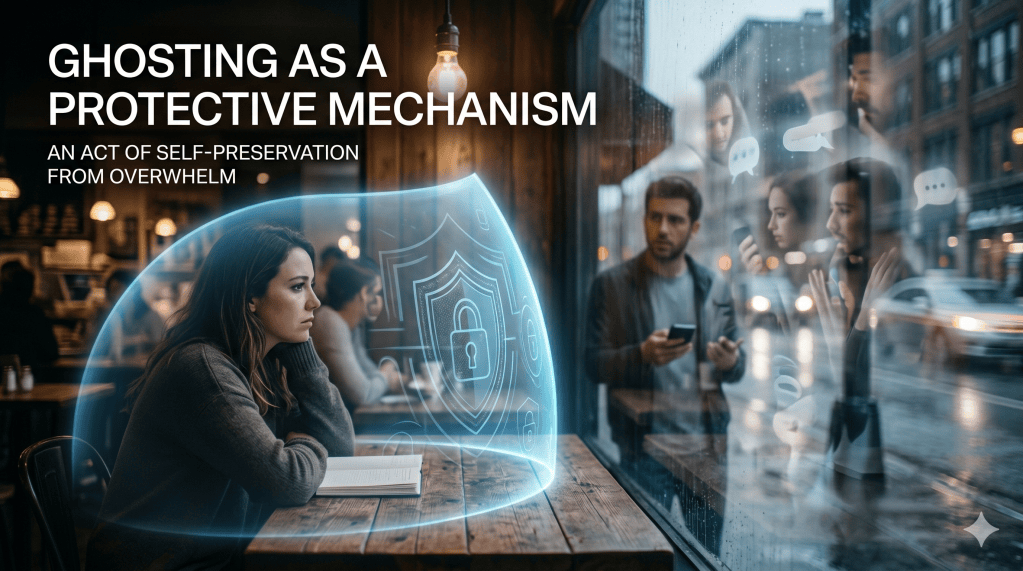
Ghosting as a protective mechanism explores the psychology, neuroscience, and social dynamics behind why people disappear — and when it’s more than just avoidance.
There is something uniquely modern about disappearing. People have always withdrawn from relationships they no longer wanted, ended friendships without explanation, and avoided difficult conversations. But ghosting — the act of cutting off all communication without warning or acknowledgment — has become a cultural phenomenon in a way that would have been nearly impossible before smartphones made constant contact the default expectation of human relationships.
We talk about ghosting mostly in the context of romantic rejection, as a form of emotional cowardice or cruelty. That framing is understandable. Being on the receiving end of a sudden, unexplained silence is genuinely painful, and the pain deserves to be taken seriously. But treating ghosting purely as bad behavior — as something that says everything about the person who does it and nothing about the environment in which it happens — misses most of the story.
Ghosting as a protective mechanism offers a more nuanced lens through which to examine the behavior. When we look at who ghosts, and why, and under what circumstances, a different picture emerges: one in which disappearing is sometimes a rational, even necessary, response to situations that feel genuinely threatening. Understanding this doesn’t excuse every instance of ghosting. It does, however, explain why the behavior has become so widespread, and what it tells us about the conditions that make it feel necessary in the first place.
The Landscape That Made Ghosting Possible
To understand why ghosting became such a defining feature of early-to-mid 21st century social life, it helps to understand what changed in the decade or so leading up to it.
The widespread adoption of smartphones, combined with the rise of social media and dating apps, fundamentally restructured how people form and maintain relationships. Meeting someone new no longer required sharing physical space. Maintaining contact no longer required a deliberate act like picking up the phone. Instead, connection became ambient — always available, always expected, always measurable in response times and read receipts and follower counts.
Dating apps in particular created something that sociologists have called the “paradox of choice” in romantic contexts. When the pool of potential partners feels effectively unlimited, the cost of walking away from any individual one feels low. It’s a structural feature of digital dating environments: when rejection can be delivered with a single left swipe, invisibly and without consequence, the social norms around how to end contact become correspondingly thin.
This matters because norms are what make hard conversations possible. In smaller social worlds — tight-knit communities, workplaces where people see each other daily, friend groups with significant overlap — the cost of leaving something unresolved is high. Avoidance creates ongoing friction. But in the fragmented, largely anonymous landscape of digital social life, avoidance has no such natural pressure valve. Disappearing becomes easy in a logistical sense, and the norms that might otherwise discourage it have not kept pace with the technology that enables it.
What the Research Actually Shows
The academic literature on ghosting has grown substantially over the past decade, and what it reveals challenges some of the simplest narratives about the behavior.
A 2019 study published in the Journal of Social and Personal Relationships found that the majority of people who reported ghosting someone cited conflict avoidance as their primary motivation. This is not a revelation on its face — of course people who stop responding to messages are trying to avoid a confrontation. But the study’s deeper finding was more interesting: most ghosters also described the situation they were exiting as one they perceived as genuinely risky in some way. Not always physically dangerous, but emotionally threatening — situations where they anticipated the other person reacting badly, becoming hostile, or refusing to accept the end of contact.
That perception of threat is worth sitting with. It suggests that for many people, ghosting isn’t chosen in a vacuum. It’s chosen in contrast to an imagined alternative that feels worse. The question then becomes: is that imagined alternative realistic? Sometimes it clearly is. Sometimes it probably isn’t. But the person making the choice is working from their own history of how ending contact has gone before.
Attachment research offers another lens. People with anxious attachment styles tend to ghost as a preemptive defense — ending contact before the other person can reject them first. Those with avoidant attachment often ghost because sustained emotional confrontation feels genuinely overwhelming, not as a performance of discomfort but as an experience of dysregulation that they lack the tools to manage.
Neuroscience offers some supporting context here. Research on social rejection has shown that the brain processes social pain using some of the same neural pathways involved in physical pain. The anterior cingulate cortex, which helps regulate pain responses, activates during experiences of social exclusion in ways that look similar on brain imaging to responses to mild physical discomfort. The overlap is partial rather than complete, but it is substantial enough to suggest that social rejection is experienced as more than a metaphorical injury. The desire to avoid anticipated rejection or conflict isn’t simply weakness — it’s connected to something that registers in the brain as a genuine threat.
When Ghosting Is, In Fact, Protective
There is a meaningful difference between ghosting someone after three dates because the conversation has become slightly awkward, and ghosting someone who has demonstrated a pattern of not accepting “no” as an answer. The first is avoidance. The second is a safety strategy.
Research on intimate partner violence and harassment has consistently found that the period of ending contact is among the most dangerous in abusive relationships. The National Domestic Violence Hotline has long provided guidance noting that leaving an abusive partner requires careful planning precisely because of the elevated risk of escalation during that period. In these contexts, ghosting — or more accurately, a sudden, complete cessation of contact — is not rudeness. It’s a survival protocol.
But danger doesn’t have to rise to the level of physical threat to make ghosting a legitimate protective choice. Consider the range of situations that fall somewhere between “mildly uncomfortable conversation” and “physically dangerous relationship”: a former partner who repeatedly texts after being told the relationship is over; a person who becomes verbally aggressive when rejected; an acquaintance whose emotional volatility has made every previous attempt at a boundary conversation a source of extended distress.
In each of these cases, a direct conversation about ending contact carries genuine costs. Those costs may not be catastrophic, but they are substantial, and the person choosing to ghost is making a judgment — sometimes correctly, sometimes not — that those costs outweigh the benefit of the explicit closure that a direct conversation would provide.
It’s also worth noting that the expectation of the explicit breakup conversation or the formal “I’m ending this friendship” exchange is itself a culturally specific norm, and one that has historically been applied unevenly. Research on gender dynamics in conflict avoidance has found that women, in particular, are more likely to use indirect exit strategies in relationships — including ghosting — partly because direct rejection more frequently provokes hostile responses from male partners. A 2021 analysis of online harassment patterns found that women who explicitly rejected men online were significantly more likely to receive threatening or abusive messages than those who simply stopped responding. If that is the realistic context in which a woman is choosing between direct rejection and disappearing, her choice to ghost looks considerably less like cowardice and considerably more like risk management.
The Psychology of Avoidance
Even when ghosting occurs outside of any context involving clear danger, it often reflects something more than simple laziness or cruelty. Avoidance, as a coping strategy, has a well-documented psychological profile.
Cognitive behavioral psychology distinguishes between two broad categories of responses to aversive situations: approach-oriented responses, in which the person moves toward the problem to resolve it, and avoidance-oriented responses, in which the person withdraws to reduce immediate distress. Avoidance is an effective short-term strategy. It reduces anxiety quickly and reliably. The problem is that it tends to maintain or worsen anxiety over time, because it prevents the person from learning that the feared outcome — the difficult conversation, the hostile response, the experience of being blamed or guilted — is survivable and manageable.
This is why therapists who work with people who habitually ghost often describe the behavior not as a character flaw but as a learned pattern that makes psychological sense given the person’s history. Someone who grew up in an environment where direct communication led to punishment, escalation, or abandonment may have developed avoidance as a genuinely adaptive response to their specific circumstances. Carrying that pattern into adult relationships is understandable, even when it causes harm.
That’s not a pass. The harm caused to the person being ghosted is real. The disorientation, the rumination, the absence of the explanation that would allow them to move on — these are legitimate costs that the ghoster’s discomfort doesn’t cancel out. But understanding the psychological origins of the behavior makes it possible to respond to it — in therapy, in relationships, in conversations about social norms — with more precision than a simple moral condemnation allows.
Digital Life and the Erosion of Conversational Norms
One of the more underappreciated drivers of ghosting is what might be called the collapse of conversational closure in digital communication. In-person conversations end naturally — people say goodbye and leave. Phone calls terminate. Even earlier text-based exchanges had clearer conventions about when a thread was finished. Persistent messaging changed that. On platforms where your entire history with a person exists in an infinite scroll, where you can see the moment a message was read, and where responding to one message simply generates the next, the obligation to keep engaging can feel endless. And ending contact explicitly creates a documented record — a message that can be screenshotted, shared, or dissected — in a way that a face-to-face conversation never could. When the available alternatives feel like they each generate their own problems, silence starts to look like the path of least resistance.
Another factor is the sheer volume of social interactions modern digital life produces. Maintaining dozens or even hundreds of loose connections through messaging platforms generates far more relationship endings than previous generations routinely encountered. When people are managing that many simultaneous ties, the cognitive burden of formally closing every unwanted interaction becomes significant in its own right. Ghosting may therefore be partly a consequence of scale — not indifference to any one person, but a kind of triage that emerges when the number of connections outpaces the social energy available to close them properly.
The Cost of Disappearing — And Who Bears It
None of this analysis is meant to minimize what ghosting does to the person on the receiving end. That experience is worth examining in its own right, because it reveals something about why ghosting has become such a charged topic.
Being ghosted activates a particular kind of psychological distress that’s different from the pain of a clear rejection. When someone says “I’m not interested” or “I don’t want to continue this relationship,” the message is painful but interpretable. The recipient knows what happened. They can grieve it, process it, and move on. Ghosting withholds that interpretive framework. It leaves the recipient in an open-ended state of uncertainty — Did something happen to them? Are they angry? Did I do something wrong? — that the mind tends to resolve by generating increasingly negative explanations.
Psychologists sometimes describe this as an “explanation vacuum”: the human mind, which is fundamentally a meaning-making apparatus, cannot comfortably tolerate an unexplained absence. It fills the gap with something, and what it fills it with is rarely flattering to the person being ghosted. Research on rejection and self-esteem has found that ambiguous rejections — the kind that don’t come with explanation — tend to produce more sustained damage to self-image than explicit rejections, precisely because the absence of explanation invites self-blame.
This asymmetry — between the person who ghosts, for whom the behavior reduces short-term distress, and the person who is ghosted, who is left in a state of protracted uncertainty — is where the ethical weight of the behavior rests. Even when ghosting makes functional sense as a protective measure, it redistributes the discomfort of ending a relationship entirely onto the other person, and often amplifies it in the process.
Social Acceptance, Generational Shift, and What’s Changing
One of the more striking developments in how ghosting is discussed is the degree to which attitudes toward it have shifted across generations. Surveys conducted in the early-to-mid 2020s consistently found that younger adults — particularly those who came of age in the era of dating apps — were significantly more likely than older adults to consider ghosting an acceptable response to unwanted contact, at least in the context of early-stage dating. Multiple surveys found that a majority of younger adults reported either ghosting someone or being ghosted at least once, suggesting the behavior had moved from exception to near-universal experience within a single generation.
This isn’t simply a matter of younger people having worse manners, though that explanation has considerable popularity with certain commentators. It reflects, at least in part, a realistic adjustment to the social landscape that younger people actually inhabit: one in which digital relationships begin faster, involve less shared social context, and carry fewer of the mutual social obligations that historically made explicit rejections feel necessary. When you meet someone through an app and have had two conversations and one date, the argument that you owe them a formal exit conversation is considerably weaker than it would be for a six-month relationship.
What’s also shifting is the conversation around reciprocal obligation in digital communication more broadly. Some communication researchers have argued that the emergence of ghosting as a norm partly reflects a necessary recalibration of expectations: that the ambient availability created by smartphones had, by the 2010s, generated an expectation of responsiveness that was neither realistic nor healthy, and that ghosting was — among other things — an uncoordinated, socially messy way of pushing back against that expectation.
There is something to this argument, though it runs the risk of rationalizing bad behavior as a form of implicit social commentary. More useful is the observation that the rise of ghosting has generated substantive conversations — in relationships, in therapy offices, in popular culture — about what people actually owe each other in digital spaces, and what kinds of closure are realistic to expect. Those conversations are ongoing, and their outcomes are not settled.
Ghosting, Self-Protection, and the Limits of Empathy
Perhaps the most honest thing to say about ghosting as a protective mechanism is that it occupies genuinely contested moral territory — and that the contest isn’t easily resolved because it involves competing legitimate interests.
On one side: the person who is disoriented, hurt, and denied the closure that would allow them to move on. Their experience is valid. The pain of ambiguous rejection is significant. Their interest in a clear, honest communication has moral weight.
On the other side: the person who has, accurately or not, assessed a situation as threatening enough that direct communication feels genuinely dangerous, or whose psychological history makes direct confrontation an experience of intense distress, or who is simply operating in a social environment where the norms around ending contact are genuinely unclear.
Both of these are genuine situations, and the same behavior — ghosting — can look like cruelty from one angle and self-preservation from another. The person being ghosted almost never knows which it is. And the person doing the ghosting is not always the most reliable narrator of their own motivations.
Looking Forward
In the years since ghosting became a widely recognized social phenomenon, there have been modest but meaningful shifts in how people talk about it. Therapists increasingly address the behavior explicitly in treatment. Relationship educators have developed frameworks for conversations about what each person in an early relationship expects in terms of communication if things don’t work out. Some dating apps have experimented with features designed to make ending connections easier and more explicit.
What the research suggests, taken together, is that ghosting is better understood as a symptom than as a cause — a symptom of the fragmented social environments digital life has created, of the inadequate norms that have emerged to govern those environments, and of the very human tendency to protect oneself from anticipated pain, whether or not that protection is well-calibrated to the actual threat. The same behavior can be a straightforwardly harmful act of avoidance in one context and a reasonable, even necessary, act of self-protection in another. The challenge is that we rarely know, from the outside, which situation we’re in. Both of those things can be true simultaneously. Learning to think with that kind of complexity is, in many ways, what navigating relationships in a digital age requires.









