
Originally published in July 2024 and comprehensively updated/edited in June 2026.
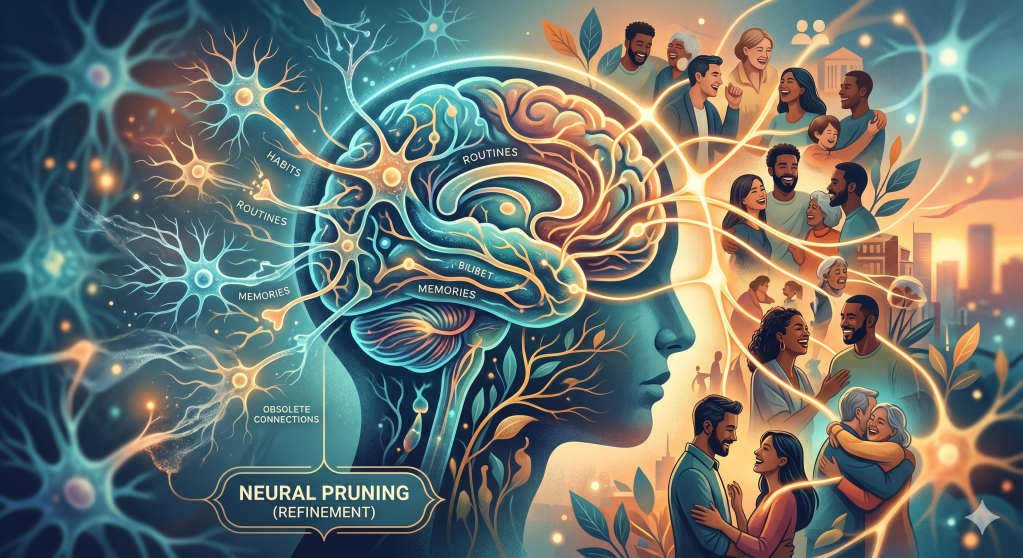
Neural pruning reshapes how the brain forms and maintains relationships from adolescence through adulthood — here’s what the science reveals about why we grow apart, and why it matters.
There is a moment most people recognize, even if they have never had a name for it. You are sitting across from someone you once knew deeply — a childhood friend, a college roommate, an ex-partner — and the conversation moves smoothly enough on the surface, but something underneath has gone quiet. The closeness that once felt automatic now requires effort. You have not had a falling-out. Nothing dramatic happened. The relationship simply… thinned.
This experience is so common it has become a kind of background noise in adult life. People grow apart. Friendships fade. The social world contracts. Most of us accept this as an ordinary feature of getting older, filing it away alongside slower metabolism and earlier bedtimes as just another thing that happens. But neuroscience has been quietly building a case that what we tend to attribute to circumstance or emotional drift is, at least in part, a biological process — one that begins long before adulthood and continues reshaping our social lives in ways we rarely notice in real time.
Neural pruning sits at the center of that story. Understanding it does not explain everything about why human relationships change, but it illuminates something that purely social or psychological explanations tend to miss: the brain may be an active participant in shaping which connections receive continued investment — and which are quietly allowed to thin.
What Neural Pruning Actually Is
The brain is not a static organ. It changes constantly in response to experience, and one of the least intuitive ways it does this is by eliminating connections rather than building them.
During fetal development and early infancy, the brain produces an enormous surplus of neurons and synapses — far more than it will ever need. This overproduction is not a mistake. It is a strategy. The developing brain casts a wide net, building connectivity in almost every direction, then waits to see what gets used. The synapses that fire regularly are reinforced. The ones that go quiet are gradually eliminated. Neuroscientists call this synaptic pruning, and it is one of the primary mechanisms through which the brain becomes efficient.
The analogy most often used is gardening: a gardener who prunes a rosebush is not harming it but shaping it, removing branches that divert energy from the ones most likely to flourish. Neural pruning works along similar lines. The brain’s resources — oxygen, glucose, the metabolic machinery required to maintain active synaptic connections — are finite. Maintaining every connection that was ever formed would be wasteful. So the brain consolidates, keeping what it uses and quietly letting the rest go.
The pruning process happens in waves across the lifespan, and the timing is not random. The visual and sensory cortices prune earliest, in the first years of life. Language areas follow. The prefrontal cortex — the region most associated with planning, impulse control, and complex social reasoning — does not complete its pruning until the mid-to-late twenties. This is part of why adolescence is such a turbulent period: the social and emotional brain is undergoing one of its most significant reorganizations precisely when social stakes feel highest.
The Adolescent Brain and the Social Surge
To understand how neural pruning shapes relationships across adulthood, it helps to start with adolescence, when the process is most dramatic and its social consequences are most visible.
Between roughly the ages of 10 and 25, the brain undergoes a period of intensive refinement. Gray matter volume, which peaks in late childhood, begins to decline as pruning accelerates. White matter — the insulated pathways that allow different brain regions to communicate efficiently — continues to develop. The result is a brain that is simultaneously losing raw connectivity and gaining coordination.
During this period, the social brain is particularly active. Research using neuroimaging has shown that adolescents show heightened activity in brain regions associated with social processing, including the medial prefrontal cortex and the temporoparietal junction, areas involved in thinking about other people’s thoughts, intentions, and feelings. Teenagers are not simply more dramatic than adults about social situations; they are processing those situations with a brain that genuinely weights them more heavily.
This heightened social sensitivity has a purpose. Adolescence is the developmental window during which humans historically moved toward independence from family and began building the peer relationships and broader social networks that would sustain them through adulthood. The brain’s sensitivity to social feedback during this period — its responsiveness to belonging and exclusion, to status and rejection — is not an accident of hormones alone. It is a feature of a system being calibrated for a new social environment.
The friendships formed during this window often feel uniquely intense, and there is a neurological basis for that perception. The dopaminergic reward system, which drives motivation and pleasure, is particularly active during adolescence, which is why social rewards — inclusion, positive peer attention, romantic connection — register so powerfully. The relationships built during this window are formed in a brain that is essentially primed to form them.
When Pruning Meets Social Reality
As the brain moves through its twenties and into early adulthood, the character of neural pruning shifts. The adolescent surge of social processing begins to settle. The prefrontal cortex, now more fully developed, exerts greater regulatory influence over emotional and social responses. The result is a brain that is, in many measurable ways, more stable — and also, in some important respects, less flexible.
Social neuroscientists have documented what appears to be a corresponding shift in social behavior. Adults in their twenties and thirties tend to begin narrowing their social circles, not as a response to any particular social failure, but as part of what researchers have identified as a broader shift in how people allocate social attention and energy.
Laura Carstensen’s socioemotional selectivity theory, developed over several decades of research at Stanford, offers one of the most influential frameworks for understanding this pattern. Carstensen proposed that people’s social goals shift depending on their perception of time. When time feels expansive — as it does in youth — people tend to prioritize breadth. They seek new connections, novel experiences, and social information that might be useful someday. When time feels more limited, as it does in middle and later adulthood, priorities shift toward depth. People invest in the relationships that matter most and let the peripheral ones recede.
What is striking about this framework is that the shift does not require aging per se. Studies have shown that young people who are seriously ill, or who are about to face major life transitions, shift toward selectivity in ways that resemble older adults. The trigger is not the number of years lived but the subjective sense of time’s horizon. The brain, in other words, is responding to perceived circumstance — and that perception is shaped by both real conditions and internal biological ones.
Neural pruning contributes to this shift in ways that are still being worked out. As the brain becomes more efficient, it also becomes more economical about where it directs resources. This includes the cognitive and emotional resources required to maintain close relationships — what researchers sometimes call the social cognitive load of friendship. Keeping up an active relationship requires remembering details about another person’s life, tracking their emotional states, anticipating their needs, and investing time and energy in shared experience. The pruned brain does not stop doing any of this, but it becomes more selective about who receives that investment.
Quality Over Quantity: The Shrinking Inner Circle
One of the most consistent findings in the social science literature on adult relationships is that the size of people’s close social networks tends to decline with age, even as overall life satisfaction often remains stable or improves. This seems counterintuitive at first — shouldn’t fewer friends mean more loneliness? — but the data suggest otherwise.
Work by Robin Dunbar, the British anthropologist known for identifying the “Dunbar number” — the cognitive limit of roughly 150 people that humans can maintain stable social relationships with — has shown that within that outer circle, people tend to organize relationships in concentric layers of closeness. The innermost layer, typically containing about five people, represents the relationships that receive the most social investment and provide the deepest support. The composition of that inner circle shifts across the lifespan, but its size tends to remain relatively constant. What changes is that people become more intentional, and often more selective, about who occupies it.
This selectivity has measurable consequences. Research consistently finds that the quality of close relationships is among the strongest predictors of both psychological well-being and physical health. The famous Harvard Study of Adult Development, which followed men from their college years into old age over the course of more than 80 years, found that the warmth and quality of close relationships in midlife was a better predictor of health and happiness in later life than cholesterol levels, income, or professional achievement. The people who thrived into old age were not the ones with the most friends or the most social activity, but the ones with the deepest connections.
Neural pruning, viewed through this lens, begins to look less like loss and more like optimization. The brain that is letting go of peripheral connectivity may be the same brain that is freeing up resources for the connections that actually sustain a person.
While Dunbar’s work focuses on cognitive limits rather than neural pruning itself, both point toward the same broader principle: human social capacity is finite. Whether measured in synapses, attention, memory, or emotional investment, the brain continually faces decisions about where to allocate limited resources. Pruning is how it resolves that constraint at the cellular level. Socioemotional selectivity is how the same logic plays out in lived social behavior. The mechanisms are different, but the direction of pressure is the same.
The Digital Complication
Any discussion of neural pruning and human relationships written in the mid-2020s has to grapple with the degree to which the social environment itself has changed — and with how poorly our evolved neural architecture maps onto that new environment.
Social media platforms were designed to engage the brain’s social reward systems. The “like” button, the notification badge, the algorithmically curated feed — these are engineered to activate the same dopaminergic mechanisms that made social feedback so compelling in adolescence, and to keep them engaged long after the pruning brain has begun shifting away from breadth and toward depth. The result is a persistent pull in the opposite direction: platforms optimized to deliver broad, shallow, high-frequency social contact to a brain that is increasingly organized around selectivity and genuine reciprocity.
This creates a mismatch that is difficult to quantify but easy to recognize. Many people report feeling simultaneously more connected and more lonely than earlier generations — a paradox that makes more sense when you understand that social stimulation and genuine social nourishment are not the same thing. The brain can be flooded with social signals while being starved of the kind of sustained, reciprocal engagement that actually maintains close bonds. Research on social media and relationship quality has produced a complicated picture overall, but the clearest finding is also the most intuitive: what matters is not how much social contact a person has, but how much of it involves real investment on both sides.
What Remains After the Pruning
One of the more consequential insights from social neuroscience is that relationships are not just things that happen to a brain — they are environments that shape it. The neuroplasticity that makes pruning possible also means that the connections a person maintains over time influence which neural pathways stay active and which continue to thin. Research has found that chronic social isolation is associated with elevated cortisol, disrupted sleep, and accelerated cognitive decline in older adults. The friendship that fades is not only a social loss; over time, it may also alter the neural patterns that sustained that relationship.
This also means the fading of relationships is not always as passive as it feels. When a friendship gradually thins over months or years of intermittent contact, the neural substrate that once supported it thins alongside it. Reactivating a dormant relationship after a long absence often feels effortful not just because of the awkwardness of reestablishing familiarity, but because the closeness itself has to be rebuilt — it is not simply waiting to be resumed.
Most cultures have well-developed rituals for mourning formal endings — deaths, divorces, breakups. Far fewer have any framework for processing the kind of loss that neural pruning and its social analogs produce: the friendship that doesn’t end so much as evaporate, the closeness that was once effortless and is now conspicuously absent. But the research on loneliness suggests that this quiet attrition matters enormously. Julianne Holt-Lunstad, a psychologist whose work on social connection and mortality has drawn significant attention, has argued that the health risks of chronic loneliness are comparable to smoking approximately 15 cigarettes a day — a comparison that captures the severity of the problem even if it somewhat oversimplifies the mechanisms involved. The same biological shifts that move people toward selective, deeper relationships can, if the process goes too far or happens under the wrong conditions, leave them dangerously thin on connection. The brain optimized for depth is only as healthy as the deep relationships it actually has.
Looking Forward
Understanding neural pruning does not come with a simple prescription, but it does reframe some of the common anxieties that surround adult social life. The contraction of social networks in adulthood is not, in itself, a failure. It reflects a developmentally appropriate shift in how the brain allocates social resources. The person with four deep, genuinely reciprocal friendships is, by most evidence, in far better social health than the person with forty acquaintances and no one to call in a crisis.
At the same time, the ease with which peripheral relationships fade means that maintaining closeness requires more deliberate effort as people age than it did in the environments where those relationships were formed. The shared context of school, college, and early career created conditions for frequent contact almost automatically. Adulthood removes most of those scaffolds. The relationships that persist are, by definition, the ones people choose to sustain.
The relationship between brain development, social behavior, and the conditions of contemporary life remains an area of active and genuinely unsettled research. What is already clear is that the mind-body division that once seemed obvious in this area has largely dissolved. The brain is social in a fundamental sense — not merely in that it handles social information, but in that it is shaped by social experience in ways that persist across the lifespan. Neural pruning and human relationships are not two separate topics that happen to intersect. They are facets of a single process: the ongoing negotiation between a biological system optimizing for efficiency and a social animal trying to build a life with other people.
The relationships that survive the pruning are not necessarily the ones that were most convenient or most proximate. They are, if the research is to be believed, the ones that mattered most — to the person, and to the brain that is inseparable from who that person is. Understanding that does not make the losses any smaller. But it does make them legible in a way they often are not, and legibility, as anyone who has sat across from a thinned relationship trying to understand what happened to it, is no small thing









