
Originally drafted in August 2024 and comprehensively updated/edited in June 2026.
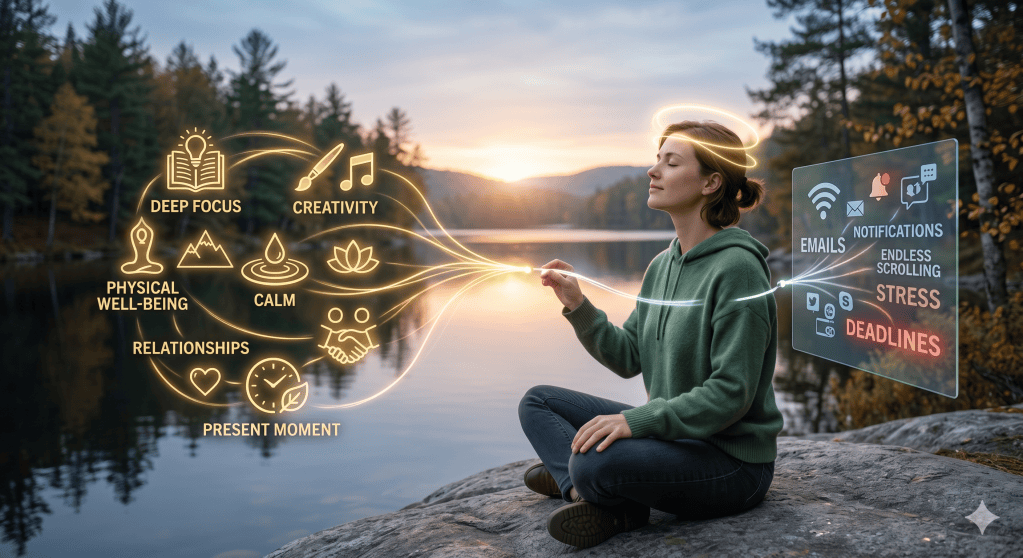
Explore the science of mental energy, attention fatigue, and why intentional digital disconnection has become a meaningful strategy for restoring cognitive and psychological health.
There is a particular kind of exhaustion that has become familiar to almost everyone alive in the digital age — one that has nothing to do with physical effort or lack of sleep. It arrives after hours of scrolling, after a day of back-to-back video calls, after a week in which your attention has been pulled in forty directions at once. You feel depleted, distracted, and strangely hollow, even if you haven’t done anything especially demanding. For millions of people, this became the defining sensation of the early-to-mid 2020s.
The period following the pandemic intensified something historically unusual: a generation that had grown up with smartphones was now working, learning, socializing, and often relaxing through the same screens. The boundaries between rest and productivity, between private life and public performance, collapsed in ways that caught most people off guard. By the time 2024 arrived, a quiet cultural movement had already begun to push back — one centered on the idea of intentionally disconnecting from digital noise in order to reclaim something that had quietly been lost: mental energy.
This article examines what mental energy actually is, what drains it, and why deliberate disconnection has emerged as one of the more evidence-supported strategies for restoring cognitive function and psychological wellbeing. It is not an argument against technology. It is an exploration of what happens inside the brain when we give it — and ourselves — room to breathe.
The Attention Economy and Its Hidden Costs
To understand why disconnecting matters, it helps to understand what we are disconnecting from. The term “attention economy” was popularized by psychologist and Nobel laureate Herbert Simon, who observed in the 1970s that a wealth of information creates a poverty of attention. Fifty years later, his insight has become the organizing principle of trillion-dollar industries.
Social media platforms, news feeds, streaming services, and mobile apps are all designed around a single goal: capturing and holding your attention for as long as possible. Every notification, every autoplay, every algorithmically curated feed is engineered to trigger a neurological response — specifically, the release of dopamine, a neurotransmitter associated with reward and motivation. When you receive a like on a post, check a news alert, or see something unexpected in your feed, your brain briefly lights up with the same circuitry involved in eating, social bonding, and other fundamental rewards.
This is not an accident, and it is not a flaw. It is the product.
The consequence, however, is a pattern of behavior that psychologists call continuous partial attention. Coined by former Apple and Microsoft executive Linda Stone, the phrase describes a state in which we are never fully present in any single activity — always scanning, always half-aware of what else might be happening somewhere else. Unlike multitasking, which implies a deliberate strategy, continuous partial attention is more reflexive. It is what happens when the environment trains you to expect constant stimulation.
Neuroscience has given us useful tools for understanding what this does to the brain. The prefrontal cortex — the region responsible for planning, decision-making, impulse control, and sustained focus — is metabolically expensive to operate. It requires significant glucose and oxygen, and it fatigues under sustained demand. When we repeatedly interrupt its function with notifications, context switches, and ambient digital noise, we are not simply dividing attention. We are depleting a finite cognitive resource.
What Mental Energy Actually Is
The phrase “mental energy” gets used casually, but the science behind it is more precise than the casual usage suggests. Psychologists Roy Baumeister and colleagues developed the concept of ego depletion in the 1990s, proposing that self-control and deliberate cognitive effort draw on a shared, limited resource — one that becomes exhausted with use, much like a muscle. Their early research, which included famous experiments where participants who resisted eating cookies performed worse on subsequent tasks, suggested that willpower itself was consumable.
The ego depletion framework has been refined and contested since then. Some replication studies in the 2010s produced weaker effects, leading to debates about the original findings. More recent research suggests the story is more nuanced: motivation, beliefs about fatigue, and the perceived meaningfulness of a task all influence how quickly mental resources are depleted. But the core observation — that sustained cognitive effort has costs, and that those costs accumulate — has held up in various forms across decades of research.
Attention restoration theory, developed by Rachel and Stephen Kaplan at the University of Michigan, offers a complementary framework. The Kaplans distinguished between two types of attention. Directed attention is the focused, effortful kind we use when reading a complex document, solving a problem, or navigating a social conflict. Involuntary attention, by contrast, is effortlessly engaged by things that are inherently interesting — a crackling fire, a body of water, an unexpected sound in a forest. The Kaplans proposed that directed attention fatigues with use, and that environments which engage involuntary attention allow the directed attention system to recover passively.
Their work, originally developed in the context of natural environments, has become increasingly relevant in the digital context for a reason they probably did not fully anticipate: digital media is almost entirely designed to commandeer involuntary attention while simultaneously demanding sustained directed attention. The result is a peculiar kind of mental drain in which you feel stimulated and exhausted at the same time.
Taken together, these theories point toward a similar conclusion. Human attention is not an infinite resource. Whether we describe the problem in terms of self-regulation, directed attention, or cognitive fatigue, the pattern remains the same: sustained demands on attention eventually require recovery. The next question is what that recovery actually looks like inside the brain.
The Neuroscience of Cognitive Rest
When the brain is not actively engaged in a directed task, it does not simply go quiet. It activates what neuroscientists call the default mode network — a set of interconnected regions that become more active during periods of rest, mind-wandering, and self-reflection. For decades, researchers regarded the default mode network as something like cognitive noise, the brain idling between tasks. More recent research has reversed that assessment entirely.
The default mode network appears to be involved in some of the most important mental functions we have: consolidating memories, imagining future scenarios, processing emotions, and building the kind of integrative understanding that allows us to make sense of our own lives. When we allow the mind to wander — during a walk, a shower, or a period of simple rest — we are not wasting cognitive resources. We are allowing a different, equally essential system to do its work.
Digital saturation interferes with this process in a specific way. Research by neuroscientist Mary Helen Immordino-Yang and colleagues has suggested that constant media engagement may deprive the default mode network of the downtime it needs to process emotionally complex information. The brain needs periods of low-stimulation to work through difficult experiences, develop empathy, and consolidate identity. When every spare moment is filled with a podcast, a scroll, or a video, that processing time disappears.
This helps explain something many people report anecdotally: that their best ideas tend to arrive not during periods of intense focus, but during walks, showers, or that drowsy period before sleep. The insight is not coincidental. It reflects the genuine cognitive work the resting brain performs when it is finally given space to operate without interruption.
The Rise of Intentional Disconnection
By the early 2020s, several cultural currents had begun to converge around the idea of stepping back from digital saturation. The “digital detox” concept had existed in wellness circles since at least the 2010s, but it took on greater urgency and broader appeal after the pandemic reshuffled the relationship between work, home, and screens.
The “quiet quitting” discourse of 2022 and the mainstream discussion of burnout — including the World Health Organization’s 2019 classification of it as an occupational phenomenon — reflected a growing public awareness that depletion had become structural, not merely personal. The growing visibility of dopamine fasting, a concept that emerged from Silicon Valley and involved temporarily abstaining from pleasurable stimuli, pointed in a similar direction.
By 2024 and into 2025, the conversation had matured. The term “dopamine detox” had been largely criticized by neuroscientists as a misapplication of how dopamine actually works — you cannot meaningfully deplete your dopamine reserves by scrolling, nor restore them by abstaining from your phone for a day. But underneath the imprecise language was a real and valid insight: the pattern of constant digital engagement creates habits of mind that make sustained focus, genuine rest, and deep presence increasingly difficult.
What emerged in its place was a more grounded concept: intentional disconnection not as punishment or deprivation, but as a deliberate reallocation of mental resources toward activities that restore rather than deplete.
What Recovery Actually Looks Like
Research into cognitive recovery has identified several conditions that appear to support genuine mental restoration. Spending time in natural environments is among the most consistently supported. Studies across cultures and populations have found that exposure to natural settings — parks, forests, coastlines, even urban green spaces — is associated with reductions in cortisol (a primary stress hormone), lower blood pressure, and improved performance on attention tasks. The effect is not merely subjective. Neuroimaging studies have shown measurable differences in brain activity, particularly in regions associated with rumination and stress response, following time in natural versus urban environments.
Physical movement also plays a significant role. Exercise reliably improves mood, reduces anxiety, and supports memory consolidation, in part through mechanisms involving brain-derived neurotrophic factor (BDNF), a protein that supports the growth and maintenance of neurons. Even moderate exercise — a brisk walk, a short bike ride — appears to benefit executive function and attentional control for hours afterward.
Social connection, particularly the face-to-face variety, engages brain systems that screen-based interaction does not activate in the same way. Research by Julianne Holt-Lunstad and colleagues has established that social isolation is associated with elevated mortality risk comparable to smoking — a finding that underscores how fundamental genuine human connection is to overall health. The substitution of digital communication for in-person interaction is not a perfect replacement; video calls and text threads are useful and real, but they appear to engage fewer of the social processing systems that in-person contact activates.
None of this requires retreating to a monastery. The growing evidence suggests that even modest shifts — a lunch hour without a phone, a morning routine that does not begin with checking email, an evening walk without earbuds — can produce meaningful cognitive benefits over time.
The Psychology of Habits and Friction
One reason intentional disconnection is difficult, even for people who genuinely want to attempt it, is that digital engagement is deeply habitual. Habits, by definition, operate below the level of conscious decision-making. Neurologically, they are governed primarily by the basal ganglia — structures that encode repeated behaviors as automatic routines in response to specific cues. The habit loop, as Charles Duhigg described it in his influential 2012 book drawing on MIT research, involves a cue, a routine, and a reward. Disrupting an established habit requires either changing the cue, substituting a different routine, or removing the reward — and digital apps are deliberately designed to maximize all three elements of that loop.
This means that disconnecting is rarely just a matter of deciding to do it. Environmental design matters enormously. Research in behavioral science has consistently shown that small changes in the physical or digital environment — what Thaler and Sunstein famously called “nudges” — have outsized effects on behavior. Placing your phone in another room, disabling notifications, or keeping your phone charger outside the bedroom are interventions that work not through willpower but through friction: they make the unwanted behavior slightly harder and the preferred behavior slightly easier.
The concept of “bright line rules” from behavioral economics is also relevant here. Research suggests that vague intentions — “I’ll try to use my phone less” — are far less effective than specific, pre-committed behaviors — “I don’t check my phone before 9 a.m.” The precision removes the need for moment-to-moment negotiation with the impulse, which is exactly where willpower tends to lose.
The Social Dimension: Why Individual Solutions Have Limits
One complication that honest accounts of digital disconnection tend to underplay is the social dimension of the problem. For many people, particularly those in certain professions or social circles, constant digital availability is not simply a personal habit — it is an expectation. The always-on work culture, the social contract of prompt text message replies, the professional norms around email response times — these are institutional and social pressures that individual behavior change alone cannot fully address.
Sociologist Arlie Hochschild’s concept of the “second shift” — the additional labor that follows a formal workday — has found a new form in what some researchers call “telepressure”: the psychological compulsion to respond quickly to digital communications. A 2014 study by Barber and Santuzzi found that telepressure was associated with burnout and sleep disruption, and that it appeared to operate independently of how much someone actually used technology — the mere awareness of unread messages was enough to generate cognitive interference.
This suggests that disconnecting to reallocate mental energy is, at its most effective, not purely a personal project. It works better when it is supported by workplace norms, social agreements, and cultural expectations that give people genuine permission to be unreachable. Countries that have experimented with “right to disconnect” legislation — France introduced such a law in 2017, and several others have followed — are grappling with exactly this institutional dimension.
Attention as a Finite and Valuable Resource
There is something worth sitting with in the idea that attention is finite. In most popular conversations about productivity and wellbeing, time is treated as the scarce resource to be managed. Time management, time blocking, time tracking — the language frames the problem as one of scheduling. But an emerging school of thought, associated with thinkers like Oliver Burkeman and research in cognitive psychology, argues that attention is actually the more fundamental constraint.
You can have all the time in the world and still accomplish nothing of value if your attention is fragmented, depleted, or perpetually hijacked. Conversely, even limited stretches of genuinely focused, restored attention can produce disproportionate results — in work, in relationships, in creative projects, in the quality of experience itself.
Disconnecting, in this framing, is less about escaping technology and more about protecting something worth protecting. It is about recognizing that the mind, like any biological system, operates better when its resources are managed rather than simply consumed. The reallocation of mental energy — from reactive scrolling and ambient digital noise toward the activities that actually matter to a person — is not a retreat from the world. It is an attempt to show up in it more fully.
Looking Forward
By the mid-2020s, the conversation about digital life and mental health had matured considerably. The early, utopian narratives about social media fostering community and the dystopian narratives about smartphones destroying mental health have both given way to more nuanced assessments. The research is ongoing, and the conclusions are rarely as clean as popular headlines suggest.
What does seem clear is that the design of digital environments will remain a significant factor in public health — not merely individual health — for the foreseeable future. The growing field of “humane technology,” represented by organizations like the Center for Humane Technology, is working to shift the incentive structures of the attention economy so that platforms are no longer optimized purely for engagement at the cost of user wellbeing. Whether those efforts gain meaningful traction against the economic forces aligned in the other direction remains an open question.
At the individual level, the case for deliberate disconnection rests on a simple and well-supported foundation: the brain is not a machine that runs better with more input. It is a biological system that requires rest, recovery, and unstructured time to function at its best. The ability to direct one’s own attention — to choose what to think about, and for how long, without constant interruption — is increasingly recognized not just as a productivity advantage but as a form of psychological freedom.
Reclaiming that freedom, even partially and imperfectly, is what the project of disconnecting to reallocate mental energy is really about.









