
Originally published in April 2025 and comprehensively updated/edited in June 2026.
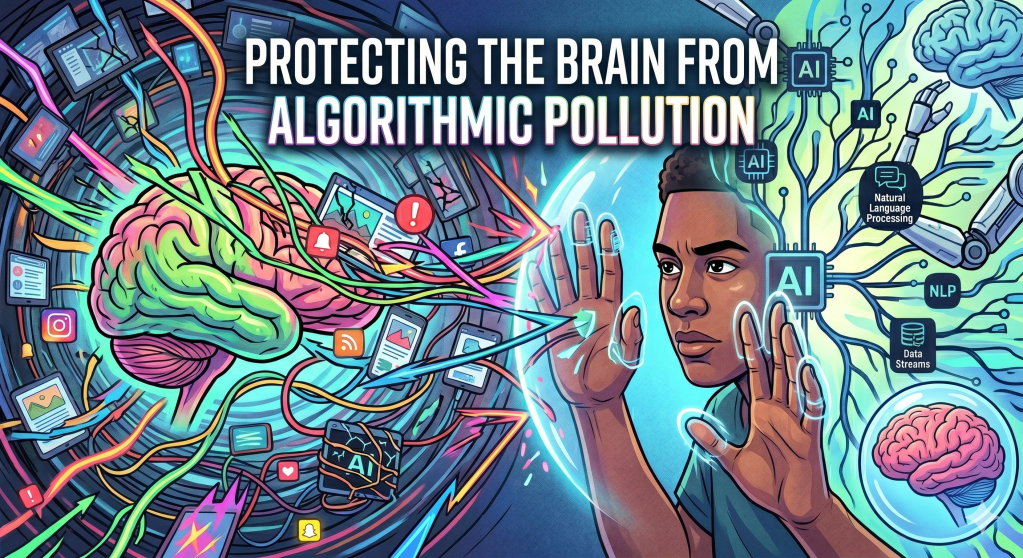
How algorithmic recommendation systems affect attention, emotional regulation, and cognition — and what psychology and neuroscience say about protecting your brain.
There is something strange happening to the way people think. Not in the dramatic, science-fiction sense of minds being hijacked by machines — but in a subtler, more insidious way that researchers, therapists, and ordinary people are only beginning to articulate clearly. Attention has become fractured. Emotional responses have grown more volatile. The ability to sit with complexity, to tolerate ambiguity, to form opinions through slow deliberation — these capacities feel, to many people, like they are quietly eroding.
Several forces have converged to produce this shift — and reducing it to “too much screen time,” a phrase that flattens a genuinely complex phenomenon into something that sounds like a parenting complaint from the early 2000s, gets us nowhere. What has emerged over the past decade is a new kind of environmental pressure on the human brain — one that psychologists and neuroscientists are beginning to study with real urgency. Call it algorithmic pollution: the cumulative cognitive and emotional effect of living inside information systems that are designed, at their core, not to inform us but to capture and hold our attention at almost any psychological cost.
Understanding this phenomenon requires looking at history, psychology, neuroscience, and the mechanics of how modern digital platforms actually work. It also requires a certain intellectual honesty about the fact that we are all, in some degree, participants in a system we did not fully choose and cannot fully escape.
How We Got Here: The Architecture of Engagement
The internet of the early 1990s was, for most users, a relatively passive experience. You went somewhere, read something, and left. Search engines, forums, and early websites were tools. They responded to your intentions rather than cultivating new ones. The relationship between user and platform was fundamentally transactional.
That began to change in the mid-2000s with the rise of social media, and accelerated dramatically after the widespread adoption of smartphones around 2010. The shift was not just technological — it was economic. Platforms discovered that advertising revenue scaled directly with time-on-site, and time-on-site scaled with emotional engagement. Content that provoked strong emotional responses — outrage, anxiety, desire, amusement — kept people scrolling longer than content that was merely informative or useful.
This created a powerful incentive structure. Recommendation algorithms were trained not on what made users feel good, informed, or fulfilled after the fact, but on what kept them engaged in the immediate moment. These are not the same thing. Research consistently shows that the content people find most compelling in the short term is often the content they later regret consuming. This gap — between what holds attention and what actually serves wellbeing — became the engine of the modern attention economy.
The Recommendation Engine and the Emotional Brain
To understand why this matters neurologically, it helps to understand something basic about how the brain processes information and emotion. Although real cognition is considerably more complex than any simple two-system model, psychologists often find it useful to distinguish between faster, more automatic forms of processing — the kind that responds rapidly to emotionally charged or threatening stimuli — and slower, more reflective forms of reasoning that allow for deliberation, context, and nuance. These modes are not opponents; they interact constantly. But they have different strengths and different vulnerabilities.
Emotional content — particularly threatening, outrage-inducing, or socially charged material — tends to activate faster, more automatic processing preferentially. That responsiveness was adaptive for most of human evolutionary history, when rapid threat detection mattered more than nuanced deliberation. The problem is that modern recommendation algorithms have become extraordinarily good at feeding content to exactly this mode of processing, over and over, in rapid succession, across hours of daily exposure.
Research from NYU’s Center for Social Media and Politics, as well as work from behavioral economists and cognitive psychologists over the past several years, has pointed toward a consistent pattern: some studies find that people who consume high volumes of algorithmically-curated content show signs of heightened emotional reactivity and greater susceptibility to binary thinking — the tendency to see complex issues in stark either/or terms. These patterns, where researchers observe them, do not appear to reflect character flaws. Evidence points toward their being, at least in part, responses to a particular kind of informational environment — though establishing causality cleanly remains an ongoing challenge for the field.
What Algorithmic Pollution Actually Does to the Brain
The term “pollution” is chosen carefully here. Environmental pollution does not require a single dramatic event to cause harm. It works through accumulation — small exposures, repeated over time, that gradually alter the biological environment in ways that impair normal function. Algorithmic pollution works similarly. No single scroll session breaks anything. The damage, if that is even the right word, accumulates through habitual exposure to an information environment that systematically biases the brain toward certain responses.
Attention and the Shrinking Focus Window
One of the most commonly discussed effects is the impact on sustained attention. There is growing evidence that the ability to focus on a single task or idea for an extended period — what cognitive scientists sometimes call “deep attention” — has shifted in measurable ways across certain populations, though researchers continue to debate the scale, the direction of causality, and what baselines are appropriate for comparison. Studies using behavioral measures and self-report data have documented increases in attentional switching, task fragmentation, and self-reported difficulty with prolonged reading or listening tasks, particularly among heavier device users.
The mechanism most researchers point to is fairly straightforward: attention is, to a meaningful degree, a trainable capacity. Like any cognitive skill, it responds to practice and to the demands placed on it by the environment. An environment that rewards constant switching — new notifications, new content, rapid context changes — trains the brain to switch constantly. An environment that requires sustained focus develops that capacity instead. The modern smartphone, with its stream of interruptions, has become one of the most pervasive attention-training devices in human history. Unfortunately, it is training attention in the wrong direction.
There is legitimate scientific debate about the extent and permanence of these effects. Some researchers caution against overstating the evidence, pointing out that studies on attention and screen use often rely on self-report, involve correlational rather than causal designs, and struggle to isolate the specific variable of algorithmic content from other lifestyle factors. These are fair methodological concerns. But the convergence of findings across different research groups, different methodologies, and different populations is difficult to dismiss entirely.
Emotional Dysregulation and the Outrage Loop
Perhaps more concerning than the effects on attention are the effects on emotional regulation. A growing body of research suggests that chronic exposure to emotionally activating content — the kind that dominates algorithmically-curated feeds — may contribute to patterns of emotional dysregulation that extend well beyond the screen.
Emotional regulation is not simply a matter of feeling good or bad. It refers to the capacity to manage emotional responses in ways that are appropriate to context: to feel angry when anger is warranted, to modulate that anger when it would be counterproductive, to return to baseline after an emotional event, and to tolerate the discomfort of complex feelings without immediately seeking to discharge them. These capacities depend on a well-functioning prefrontal cortex and on patterns of emotional learning developed over time.
When people are repeatedly exposed to content designed to trigger emotional responses — particularly anger and anxiety, which are especially effective at driving engagement — they can develop what some researchers describe as a kind of emotional hypervigilance. The brain’s threat-detection system is put on frequent low-level alert. Baseline cortisol levels (a stress hormone) may rise. The threshold for experiencing something as threatening or outrage-worthy may lower. Over time, this can contribute to a state that clinically resembles low-grade chronic stress, even when no single stressor is identifiable.
The concern is that emotional dysregulation can have downstream effects on nearly every area of cognitive functioning. Research suggests memory consolidation may be impaired under chronic stress conditions. Decision-making can become more impulsive. Social perception — the ability to accurately read other people’s intentions and emotions — may become distorted, particularly in the direction of perceiving hostility where none exists. People who spend significant portions of their day inside an algorithmically-managed outrage loop may find, over time, that the world begins to feel more threatening and hostile than it actually is.
The Epistemological Problem: What We Think We Know
There is a third dimension of algorithmic pollution that is less about individual psychology and more about collective epistemology — the shared processes by which communities and societies develop beliefs about what is true. This is where the social effects of algorithmic recommendation become particularly pronounced.
Recommendation algorithms, by design, show people content that resembles what they have already engaged with. This creates information environments that are, in the aggregate, less diverse than the actual landscape of available information. The well-documented “filter bubble” effect — a term coined by researcher Eli Pariser — describes this narrowing of exposure. People do not simply encounter confirming information more often; they encounter proportionally less disconfirming information, less genuine diversity of perspective, and less content that challenges existing beliefs in productive ways.
The cognitive consequence of this is a phenomenon psychologists call belief perseverance combined with what is sometimes called “the illusion of explanatory depth” — the tendency to feel more confident about complex topics than is actually warranted by one’s actual knowledge of them. People who primarily consume ideologically consistent information tend to report higher confidence in their beliefs, not because those beliefs are more accurate, but because the information environment has provided fewer opportunities for productive challenge and revision.
Worth noting: none of this targets any particular political orientation. The research suggests these dynamics operate across the ideological spectrum, albeit with some variation in which types of content are most algorithmically amplified for different groups at different times. The deeper issue is structural: an information environment that optimizes for engagement rather than accuracy, diversity, or productive challenge is one that systematically undermines the epistemological habits that good collective reasoning requires.
Social Comparison and the Distorted Mirror
Alongside the effects of content recommendation, social media has introduced a second major source of psychological pressure: the systematic distortion of social comparison. Human beings are deeply social creatures, and social comparison — the process of evaluating oneself relative to others — is a normal and often adaptive cognitive process. We learn from others, calibrate our behavior to social norms, and develop a sense of where we stand in communities that matter to us. None of this is pathological in itself.
What social media has done is alter the reference population for social comparison in ways that are almost uniformly unflattering. Before the digital era, most people compared themselves to people they actually knew — neighbors, coworkers, classmates — who were, by definition, drawn from a realistic local distribution of achievement, appearance, wealth, and happiness. Social media replaced this with a global, algorithmically-curated highlight reel: not a realistic sample of human experience, but a filtered selection of its most attractive, successful, and photogenic moments.
Research by social psychologist Jean Twenge and others has documented correlations between heavy social media use and increased rates of depression, anxiety, and loneliness, particularly among adolescents and young adults. The causal picture remains genuinely debated — some researchers argue the correlations are largely driven by pre-existing vulnerability, while others point to experimental evidence suggesting social media use can induce negative mood states in previously stable individuals. The most defensible reading of the current literature is that both processes are probably operating: social media use appears to worsen outcomes in vulnerable individuals, and some effects seem to emerge even in psychologically healthy people exposed to certain types of content at high volumes.
The mechanism most consistently implicated is upward social comparison: evaluating oneself unfavorably against others who appear more successful, more attractive, happier, or more socially connected. Platforms designed around follower counts, like counts, and visible metrics of social approval create a continuous, quantified social comparison environment that most human psychology is not particularly well-equipped to handle at scale.
What makes this especially complex is the rise of the influencer economy — a professional class whose livelihood depends on performing an aspirational version of everyday life for a mass audience. The content that fills social feeds is not merely the organic self-presentation of ordinary people; it increasingly consists of carefully produced material designed to appear spontaneous while actually being optimized for maximum emotional impact. The gap between what people see and what is real has never been wider, even as the presentation has never felt more intimate.
This intimacy is itself part of the psychological mechanism. Parasocial relationships — the one-sided emotional bonds people form with media figures, celebrities, or online personalities — have existed since the age of radio and television. What is new is the scale, the interactivity, and the personalization. Algorithms surface the same creators repeatedly, creating a sense of ongoing relationship and familiarity. People come to feel they know these figures. The emotional investment is genuine even when the relationship is entirely constructed. And when the lifestyle being presented — the body, the home, the relationship, the income — becomes the unconscious standard against which one measures one’s own life, the psychological cost can be significant.
There is also the dimension of perpetual visibility. Many social platforms are designed around the implicit expectation that users will share their lives continuously — that experiences gain value by being documented and broadcast. This creates an unusual psychological pressure: the sense that one is always potentially on display, always subject to evaluation, always accumulating or losing social approval in the form of engagement metrics. Researchers studying adolescent psychology have noted that this condition of perpetual visibility may interfere with identity development, which typically requires periods of experimentation, failure, and revision that are not subject to public record.
The quantification of social approval — the translation of human connection into countable units like followers, likes, and shares — adds another layer of complexity. Human social systems have always involved status hierarchies, but they have rarely been so precisely measured or so continuously visible. When every post receives a visible score, and when that score influences how widely the platform distributes future content, the feedback loop between self-presentation and approval-seeking becomes unusually tight. Some researchers have compared it to a slot machine: the variable and unpredictable nature of social feedback makes it particularly compelling, and particularly difficult to disengage from voluntarily.
What Protection Actually Looks Like
Understanding algorithmic pollution does not lead inevitably to pessimism. The brain is not simply a passive receiver of environmental influence — it is an active, adaptive organ capable of significant change in response to deliberate practice. The question of how to protect cognitive and emotional function in a high-algorithm environment is increasingly the subject of both research and practical experimentation.
Deliberate Attention Training
One of the most robustly supported interventions is deliberate attention training — practices that require sustained focus on a single object or task over extended periods. Mindfulness meditation is the most widely studied form of this, with a substantial body of research suggesting that regular practice strengthens the prefrontal control circuits associated with attention regulation, emotional modulation, and cognitive flexibility. Other activities that require deep, sustained attention — reading long-form text, learning a complex skill, engaging in demanding creative work — appear to produce similar benefits, though they are less studied than formal meditation.
The principle underlying all of these interventions is essentially the same: the brain develops what it practices. If the dominant attentional experience is rapid switching between short content fragments, the brain becomes better at rapid switching. If the dominant attentional experience is sustained focus, the brain becomes better at that. Far from being a mystical idea, this reflects well-established principles of neuroplasticity — the brain’s capacity to reorganize and strengthen connections in response to experience.
Environmental Design and Digital Ecology
A second category of intervention involves what researchers and designers sometimes call “environmental design” — deliberately shaping the digital environment to reduce the automated pull of algorithmic systems. This includes relatively simple modifications: turning off notification badges, removing social media apps from the home screen, using website blockers during focused work periods, or adopting intentional “consumption windows” rather than allowing continuous ambient access throughout the day.
These interventions matter because much of the cognitive cost of algorithmic pollution comes not from deliberate choices to engage but from habitual, semi-automatic responses to environmental cues. The phone on the desk, the notification sound, the moment of boredom that triggers reflexive scrolling — these are not decisions in any meaningful sense. They are behavioral responses that have been conditioned through repeated association. Altering the environment reduces the frequency of the cue and, over time, weakens the habitual response.
Research on behavior change consistently shows that environmental modification is more effective than reliance on willpower alone. Willpower is a limited resource that depletes with use. A well-designed environment requires less willpower because it simply presents fewer occasions for the behavior you are trying to reduce.
Information Hygiene and Epistemic Diversity
A third area involves what might be called information hygiene — deliberate management of one’s information diet with attention to diversity, source quality, and the balance between emotionally activating and analytically demanding content. This does not mean avoiding all challenging or emotionally resonant information; such avoidance would be both impossible and undesirable. It means cultivating awareness of the difference between information that genuinely informs and content that merely activates, and making somewhat more deliberate choices about the ratio between them.
It also means actively seeking out sources that present perspectives genuinely different from one’s existing views — not for the sake of performative open-mindedness, but because genuine epistemic diversity is what allows belief revision to occur. A diet of exclusively confirming information produces confident but brittle beliefs. Exposure to well-articulated alternative views, even ones ultimately rejected, produces beliefs that are better tested and more accurately calibrated to reality.
The Structural Question Behind the Individual One
It would be incomplete to discuss algorithmic pollution purely in terms of individual coping strategies without acknowledging that the problem is, at its root, structural. The cognitive and emotional consequences described in this article are not accidents or side effects in any incidental sense. They are the predictable outcome of economic incentives that reward engagement above all else — incentives that have been understood by platform engineers and executives for well over a decade.
Regulatory responses to these incentives have been slow and, to date, largely inadequate. The European Union’s Digital Services Act, implemented in phases beginning in 2023 and expanded in subsequent years, represents one of the more serious legislative attempts to impose accountability on recommendation systems, requiring large platforms to audit their algorithmic effects and provide users with meaningful alternatives to engagement-optimized recommendation. Similar legislation has been proposed in the United States with limited success, while advocacy groups, researchers, and some former platform employees have continued to push for broader reform.
The scientific community has also begun to organize more formally around these questions. Researchers from psychology, neuroscience, public health, and computer science have called for more transparent disclosure of algorithmic systems, more rigorous independent study of platform effects, and greater integration of wellbeing metrics into the design of recommendation systems. Whether these calls produce meaningful change will depend on political will that has so far been elusive.
A Forward-Looking Perspective
The story of algorithmic pollution is still being written. The most severe long-term effects — if they exist at scale — may not be fully visible for another decade or more, when researchers will have the longitudinal data needed to draw cleaner causal conclusions. What is already clear is that the human brain did not evolve for the informational environment that now dominates daily life for hundreds of millions of people, and that the gap between our evolved cognitive architecture and our current digital ecology has measurable psychological consequences.
The condition is also not fixed. The brain is adaptive. Social systems change. Economic incentives can be restructured. Technologies that currently optimize for engagement can, in principle, be redesigned to optimize for other outcomes — accuracy, wellbeing, productive civic participation — if the will to do so develops.
The most important shift may be cognitive and cultural rather than regulatory: a broader recognition that attention is not simply a resource to be captured but a capacity to be cultivated; that emotional reactivity is not the same as genuine engagement with the world; and that the quality of one’s information environment is at least as important to cognitive health as the more commonly discussed variables of sleep, exercise, and nutrition.
Protecting the brain from algorithmic pollution has nothing to do with rejecting technology or retreating into a romanticized analog past. It is about developing a clearer understanding of the pressures that modern digital environments place on cognition, and making more deliberate choices about how to navigate them. That understanding is still developing. But the outline is becoming visible — and it is worth taking seriously.









