
Why Unoccupied Cognitive Space Reclaims Creativity, Focus, and the Architecture of Meaning
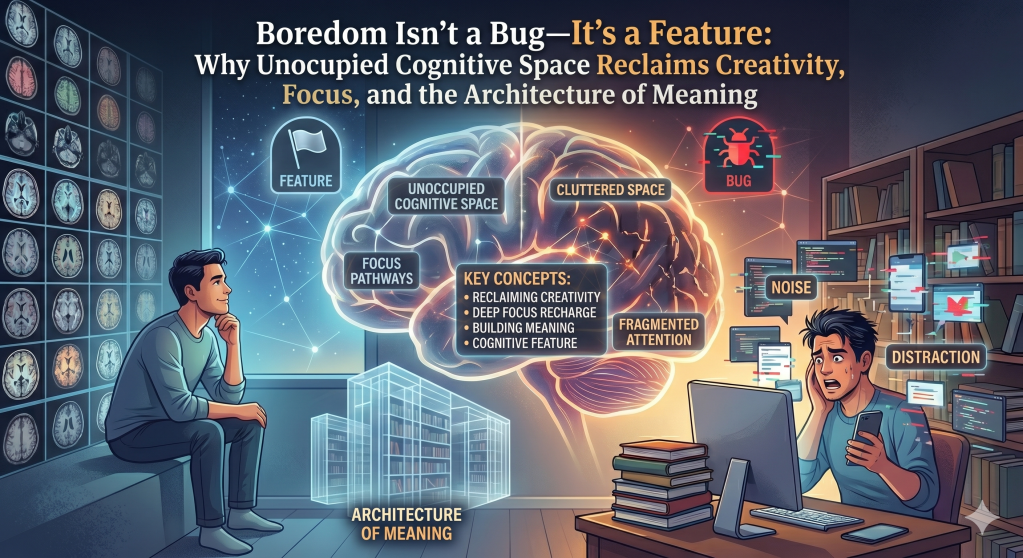
Boredom isn’t wasted time—neuroscience shows it activates the brain’s Default Mode Network, fueling creativity, self-awareness, and meaning. Here’s what we lose when we never stop scrolling.
Think about the last time you were truly bored—not the kind of boredom that comes from waiting in a long line with your phone in hand, but the deep, restless variety that settles in when there is absolutely nothing to occupy your attention. No screen, no podcast, no stream of notifications. Just you and the quiet hum of your own thoughts.
If that scenario feels foreign, or even vaguely uncomfortable, you are not alone. For most people living in connected, information-saturated environments, genuine boredom has become almost structurally impossible. Every spare moment—the elevator ride, the two-minute wait for coffee, the commercial break that no longer exists because we stream everything—has been colonized by digital content. We have engineered boredom out of daily life with the same efficiency we once applied to eliminating physical discomfort.
The problem, according to a growing body of psychological and neurological research, is that we may have made a serious mistake. Boredom, as it turns out, is not simply the absence of stimulation. It is an active mental state with real biological purpose. Far from being a flaw in human cognition, the capacity for boredom appears to be one of the mind’s most important features—a gateway to creativity, self-awareness, and the kind of deep thinking that gives life a sense of direction and meaning.
Understanding what happens when we abolish it entirely begins with understanding what boredom actually is, and what the brain does when we finally stop feeding it input.
The Uncomfortable Truth About an Idle Mind
In 2014, social psychologists Timothy Wilson and Daniel Gilbert conducted a study that remains one of the most striking demonstrations of just how poorly humans tolerate mental stillness. Participants were placed alone in a sparse room for six to fifteen minutes. There were no phones, no reading material, no distractions of any kind. The only instruction was simple: entertain yourself with your thoughts.
The room contained one other object—a button connected to a mild electric shock device. Before the study began, each participant had confirmed they found the shock unpleasant and would pay money to avoid experiencing it again.
What happened next was unexpected. When left alone with nothing but their own minds, 67 percent of male participants and 25 percent of female participants chose to administer the shock to themselves rather than simply sit in silence. They actively chose physical pain over unoccupied thought.
The results were not a statistical anomaly. They pointed to something deeper: a genuine aversion to the unengaged mind that appears to be wired into human psychology. When external stimulation disappears, the mind does not slip comfortably into rest. Instead, it experiences a form of restlessness that many people find viscerally uncomfortable—uncomfortable enough, apparently, to choose pain as an alternative.
This response makes more sense when you understand what the brain actually does when you stop giving it something to react to.
The Hidden Engine Running in the Background
For much of the twentieth century, neuroscientists assumed that when a person was not actively engaged in a task, the brain was simply at rest—idling, as it were, like a car engine waiting at a red light. The discovery that overturned this assumption came from neuroscientist Marcus Raichle in the early 2000s, when brain imaging technology became sophisticated enough to monitor neural activity in resting states.
What Raichle found was that the brain never truly goes quiet. When a person stops focusing on an external task, a distinct and interconnected set of brain regions switches on with measurable intensity. He called it the Default Mode Network, or DMN—a system involving, among other regions, the medial prefrontal cortex and the posterior cingulate cortex. These areas are associated with self-referential thinking, memory retrieval, social cognition, and imagining the future.
Here is the critical dynamic: when you are actively concentrating on something external—answering an email, solving a math problem, navigating a conversation—the brain’s executive network takes over, and the Default Mode Network is suppressed. The moment that external demand drops away, the executive network dims and the DMN takes the wheel.
The DMN is not a passive idle mode. It is the neurological engine that runs when the brain shifts from reacting to the world around it and starts processing the world within. Memory consolidation, future planning, emotional integration, and aspects of moral reasoning all appear to involve activity across the Default Mode Network. In the language of cognitive science, this is where autobiographical thinking happens: the ongoing, largely unconscious process of weaving your experiences, values, and memories into a coherent sense of who you are.
Put simply, the Default Mode Network appears to play a central role in the brain’s ongoing process of making sense of itself. And it thrives in moments when attention is not continuously directed outward.
Boredom as the Spark, Not the Void
The connection between boredom and creativity is more direct than most people realize. It is not a metaphor or a loose cultural observation—it has been tested in laboratory conditions and measured with quantifiable outcomes.
Researchers Sandi Mann and Rebekah Cadman published a study in 2014 examining whether boredom could generate measurable improvements in creative thinking. Participants in one group were assigned an intentionally tedious task: copying phone numbers out of a directory by hand. The other group went straight to a series of creative problem-solving exercises without the boredom-inducing preamble.
The group that had been bored first performed significantly better on the creative tasks. What the study suggested was not simply that boredom makes people more motivated to be creative—it’s that the boredom itself appeared to prime the brain for divergent thinking. Forcing the mind into a state of cognitive understimulation seemed to activate the same DMN-driven processes that generate novel associations, unexpected connections between distant ideas, and the kind of lateral thinking that cannot be forced through effort alone.
This is why so many people report their best ideas arriving in the shower, during a long walk, or while doing something mindlessly repetitive like washing dishes. These are all moments of mild, voluntary boredom—states where the conscious mind is occupied just enough to stop micromanaging, and the DMN is free to wander through memory and imagination without interference.
When you replace every one of those moments with a podcast or a scroll through social media, you are not filling empty time. You are closing a door that the brain was trying to open.
Of course, chronic understimulation can become genuinely distressing—and that is not the same thing as the temporary, mild boredom being discussed here. The research points to a productive threshold of mental quiet, not to prolonged, unrelenting emptiness as some kind of ideal.
The Existential Discomfort We Keep Running From
The Default Mode Network does not just generate creative ideas. It also raises hard questions—and this, more than anything else, may explain why boredom feels so threatening.
When the noise of external life fades and the DMN takes over, the mind tends to drift toward territory that is harder to navigate: questions about purpose, about whether the life being lived is aligned with what actually matters, about relationships and regrets and what comes next. These are not pleasant topics to dwell on, particularly when they do not resolve neatly. They carry with them a low-grade ambient anxiety, the kind that does not announce itself as a crisis but simply hums in the background as a vague sense of unease.
This dynamic resembles what Arthur C. Brooks has called a “doom loop of meaning”—a pattern in which attempts to avoid existential discomfort prevent the deeper reflection required to resolve it. The mind reaches toward meaning-making; meaning-making requires sitting with uncomfortable uncertainty; discomfort triggers an impulse toward avoidance; avoidance is immediately available in the form of a smartphone. We protect ourselves from a few minutes of existential restlessness by preventing ourselves from ever constructing the sustained self-reflection that gives life coherence.
Clinical psychology has documented for decades that habitual experiential avoidance—systematically escaping uncomfortable internal states rather than tolerating and processing them—is closely associated with anxiety disorders, depression, and a diminished capacity to find satisfaction in ordinary experience. When the avoidance mechanism is always in your pocket and always one tap away, it can become nearly constant.
For many people, the modern smartphone functions as an extraordinarily efficient anxiety-suppression mechanism—one that short-circuits the DMN’s meaning-making processes just as they are getting started, replacing them with fast, reward-driven feedback loops reinforced by dopamine signaling and algorithmic content streams designed to hold attention rather than restore it.
What Constant Stimulation Actually Costs
The short-term logic of constant stimulation is easy to follow. The discomfort of boredom is real. The relief offered by a screen is immediate. Dopamine is a persuasive reward signal.
But the costs accumulate over time in ways that are harder to observe precisely because they involve the absence of things—creative insights that never arrived, self-knowledge that was never developed, meaning that was never built.
Neuroscientist Marcus Raichle’s research on the Default Mode Network established that this network is metabolically expensive. The brain devotes significant energy to running it. That investment suggests it is not an accident of evolution—it is a system the brain considers important enough to maintain as its default state. When we continuously suppress it through relentless external stimulation, we are not using the brain more efficiently. We may be interrupting a process the brain appears to treat as fundamental.
There is also the matter of attention itself. The capacity for sustained, voluntary attention—the ability to stay focused on a single thing for an extended period without needing external novelty to maintain engagement—is a trained cognitive skill. It requires practice, and like any skill, it atrophies when neglected. Gloria Mark, a professor of informatics at the University of California, Irvine, has spent over two decades tracking how technology reshapes human attention. Her 2023 book Attention Span synthesizes that research with a striking finding: the average time people spend focused on a single screen before switching has dropped to roughly 47 seconds, down from about 150 seconds in the early 2000s. A mind accustomed to constant context-switching between micro-bursts of digital content does not simply struggle to focus on demanding work. It begins to struggle to find satisfaction in anything that doesn’t generate its own stimulation—books, conversations, nature, the texture of slow experience.
Rebuilding a Tolerance for Stillness
None of this is an argument for avoiding technology or romanticizing a pre-digital past. The tools available today represent genuine capabilities that did not previously exist, and using them purposefully is not the same as being enslaved to them. The distinction is whether you are choosing the stimulation or the stimulation is choosing you.
Rebuilding a tolerance for boredom does not require dramatic gestures. It begins with creating small spaces where the phone is simply not an option—meals without devices, brief outdoor walks without earbuds, ten minutes before sleep without a screen. Initially, many people report that these gaps feel uncomfortable, even agitated. That discomfort is the mind reasserting itself after a period of overstimulation. With repetition, the discomfort diminishes.
The neurological explanation for this shift is relatively straightforward: when the brain is habituated to constant stimulation, its dopamine sensitivity calibrates accordingly. Remove the stimulation, and the system protests. Sustain the removal long enough, and the baseline recalibrates to find ordinary, quieter experience more rewarding than it did before.
This is the paradox that sits at the heart of the research: people who deliberately cultivate boredom tend to become less bored overall. Their work becomes more engaging because they can sustain attention. Their relationships deepen because they can be genuinely present. Their inner lives become richer because they have given the DMN space to process, consolidate, and create.
The neuroscience here is not speculative. The clinical findings on avoidance are not new. What is relatively new is the scale at which the avoidance mechanisms have been deployed—and the degree to which a generation has grown up treating mental stillness as something to be immediately corrected rather than patiently inhabited.
What We Lose When the Mind Never Wanders
It is worth pausing on what the brain is actually trying to do when it enters the Default Mode Network, because the word “boredom” undersells it considerably.
When the DMN is active, the brain is not simply spinning its wheels. It is integrating experience, simulating future scenarios, and performing the kind of social cognition that underlies empathy—modeling other people’s motivations, preparing for the friction and warmth of human connection. These processes cannot be scheduled. They require time that is not otherwise occupied. They happen, largely, in the spaces between.
When those spaces are always filled, something is deferred indefinitely. The existential questions get asked and immediately suppressed before any answer can take shape. The cumulative result is a kind of interior poverty that coexists with extraordinary external richness—a life full of content and stimulation that somehow feels thinner than it should.
The Broader Picture
What makes this moment worth examining carefully is the combination of scale and speed. Humans have always sought distraction; the impulse is not new. What is new is the degree to which that impulse has been industrialized—optimized, personalized, made frictionless, and delivered continuously at a scale that previous forms of entertainment could never match.
The research discussed here—Wilson and Gilbert’s shock study, Mann and Cadman’s creativity findings, Raichle’s DMN work—was not conducted in response to smartphones. These are investigations into fundamental features of human cognition that have always been true. But they take on new relevance in a context where the mechanisms for avoiding unoccupied mind-time have never been more powerful or more accessible.
Understanding that boredom is not an enemy of productivity or wellbeing, but a precondition for both, offers a different frame for thinking about how we design our daily lives. It suggests that the goal is not to optimize every minute but to protect the unoptimized ones—to treat emptiness not as a failure of scheduling but as a resource worth preserving.
Boredom is often treated as a signal that something is wrong, when it may actually be a signal that deeper cognitive work is about to begin.
The capacity to be bored, and to sit with that boredom long enough for something more interesting to emerge from it, may be one of the more underrated cognitive skills of the current moment. Not because it leads to some romanticized ideal of deep thinking, but because it allows the brain to do the work it was designed to do: integrate experience, generate original thought, build coherent meaning, and stay genuinely curious about an existence that is—when given the space to be encountered directly—far more interesting than anything in a feed.
The phone will always be there. The stillness, if you don’t protect it, won’t be.
Scientific References
Mann, S., & Cadman, R. (2014). Does being bored make us more creative? Creativity Research Journal, 26(2), 165–173. https://doi.org/10.1080/10400419.2014.901073
Mark, G. (2023). Attention Span: A Groundbreaking Way to Restore Balance, Happiness and Productivity. Hanover Square Press.
Raichle, M. E., MacLeod, A. M., Snyder, A. Z., Powers, W. J., Gusnard, D. A., & Shulman, G. L. (2001). A default mode of brain function. Proceedings of the National Academy of Sciences, 98(2), 676–682. https://doi.org/10.1073/pnas.98.2.676
Wilson, T. D., Reinhard, D. A., Westgate, E. C., Gilbert, D. T., Ellerbeck, N., Cherini, C., Brown, C. L., & Westgate, A. (2014). Just think: The challenges of the disengaged mind. Science, 345(6192), 75–78. https://doi.org/10.1126/science.1250830